Amarnath Yatra 2026:
Complete Guide, Dates, Registration, Routes & Tips
Everything you need to plan the most extraordinary Himalayan pilgrimage of your life, Amarnath Yatra 2026 dates (July 3 – August 28), registration steps, Pahalgam vs Baltal route, CHC medical certificate, helicopter booking, RFID card & live darshan online.
✦ Updated April 2026 · Registration Opens April 15
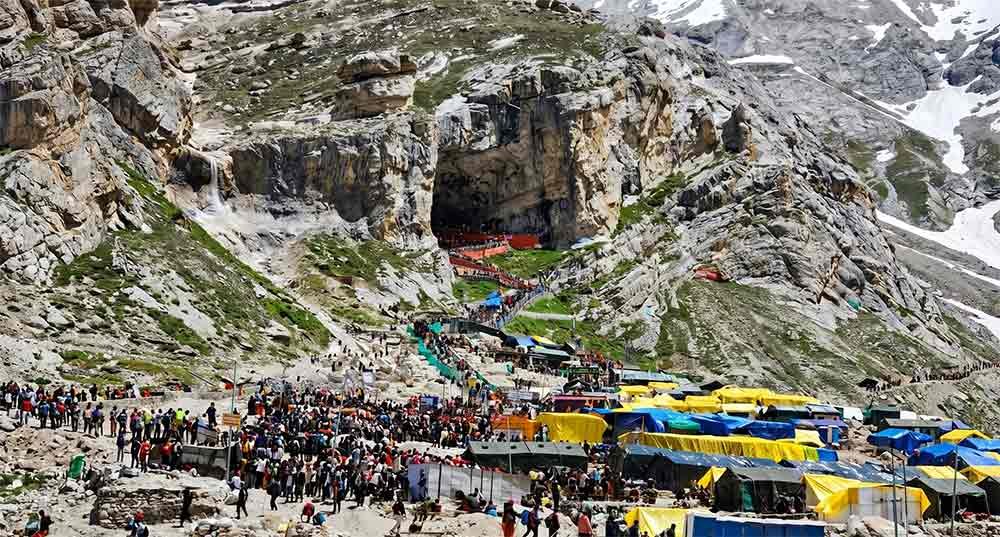
There is a cave in the Kashmir Himalayas at 3,888 metres above sea level. It has no priest, no ritual fire, no human-built altar. Inside it, fed by the cold mountain air and the particular alchemy of that altitude, a column of ice forms each year from a natural spring, rising and falling with the lunar cycle, and takes the unmistakable shape of a Shivalinga.
Nobody installed it. Nobody carved it. Nobody placed it there. It appears, every year, by itself, swayambhu, as it has for as long as anyone can remember. And every year, lakhs of devotees cross glaciers, climb mountain passes, brave altitude sickness, unpredictable weather, and terrain that would make most recreational hikers reconsider, to stand before it for a few minutes. Just to be in that cave.
The Amarnath Yatra 2026 runs from July 3 to August 28, a 57-day window during which the Himalayan passes are clear enough, the weather cooperative enough, and the ice Shivalinga fully formed. Registration opened on April 15, 2026. If you are planning to go this year, the time to begin preparing is now, not next month, not after the registration fills up.
This guide covers everything with the honesty the Amarnath Yatra demands: the Amar Katha and why this cave matters beyond ordinary temple logic, the key dates, the mandatory registration and medical certificate process, the Pahalgam and Baltal routes compared waypoint by waypoint, helicopter options, the RFID card system, packing for 3,888 metres in Himalayan monsoon, safety rules that can genuinely save your life, and how to watch live darshan on LiveDarshanHub when the mountain is not accessible this year.
Har Har Mahadev. Bam Bam Bhole. 🙏
Amarnath Yatra 2026 — At a Glance
The Amar Katha — The Story That Makes This Cave Unlike Any Other
Before logistics, before registration, before you start comparing Baltal and Pahalgam, there is a story you need to know. Because the Amarnath cave is not simply a temple that happens to be at a high altitude. It is the specific location of one of the most profound moments in all of Hindu mythology.
The story goes like this. Goddess Parvati, watching the world around her filled with death and impermanence, asked Lord Shiva a question that had been weighing on her for ages: Why do you wear a garland of skulls? Why does death exist? And why, my Lord, are you eternal, while I must keep dying and taking rebirth, life after life?
Shiva agreed to tell her. But the secret he was about to share, the Amar Katha, the tale of immortality, was so potent that no other living being could hear it. If any creature overheard even a fragment, they would become immortal too, which would throw all of creation into imbalance.
So Lord Shiva began a journey, leaving behind, one by one, everything that lived with him. At Pahalgam, he left his mount, Nandi the bull. At Chandanwari, he released the Ganga from his matted hair. At Sheshnag Lake, he removed the serpent Vasuki from his neck. At Mahagunas Pass, he left the five elements. At Panjtarni, he left behind the five Panchatattvas. And finally, at Chandanwari, he left the moon, Chandra, from his forehead.
He then entered this cave, alone with Parvati, lit a fire, and began to speak the Amar Katha. But two dove eggs near the entrance of the cave hatched during the telling, and the newborn doves heard enough to become immortal. Those two doves, tradition holds, still live near the cave, and pilgrims who spot them consider it the greatest blessing of their visit.
The ice Shivalinga inside the cave is the physical manifestation of that divine presence, Shiva himself, marking the spot where immortality was revealed. It waxes with the waxing moon and wanes with the waning moon. It reaches its fullest height during Shravan Purnima, which is why the first week of July and Shravan Mondays are the most sought-after dates for darshan, when the lingam is at its most magnificent.
The Amarnath cave darshan is streamed live on LiveDarshanHub during the 2026 yatra season, July 3 to August 28. Watch the ice, Shivalinga, the sacred cave, and the darshan live. Bhole Baba’s blessings have no altitude limit.
🔴 Watch Amarnath Live Darshan — LiveDarshanHub →Amarnath Yatra 2026 — Official Dates & Key Milestones
The 2026 dates are officially confirmed by the Shri Amarnathji Shrine Board (SASB). The yatra begins on Skanda Shashti and concludes on Raksha Bandhan / Shravan Purnima — a 57-day window. Here is every date you need to mark in your calendar right now:
| Date / Milestone | Details |
|---|---|
| April 15, 2026 | 🗓️ Advance Registration Opens, online via jksasb.nic.in AND offline at designated bank branches and Shrine Board counters across India |
| April–May 2026 | CHC (Compulsory Health Certificate) collection begins at authorised medical centres. Get yours done as soon as registration opens. CHC has a validity period and must not expire before your yatra date. |
| April–May 2026 | Helicopter ticket booking opens on the official SASB portal (jksasb.nic.in), book immediately on opening day for popular dates; seats for Shravan Mondays sell out within hours |
| July 3, 2026 | 🔱 Yatra Opens, first darshan of the season on Skanda Shashti. The ice Shivalinga is freshly formed and at its most powerful. First Shravan Monday falls within the first two weeks, the most sought-after date of the season. |
| July 3 – August 28 | Active yatra season, pilgrims begin their treks daily from Pahalgam and Baltal. Helicopter services operate weather permitting. Daily pilgrim caps are enforced at all checkpoints. |
| Shravan Mondays (July–August) | Most auspicious days, thousands of extra pilgrims. Ice Shivalinga is at or near its peak height. Book your dates and helicopter slots months in advance if your visit coincides with a Shravan Monday. |
| August 28, 2026 | 🌕 Yatra Closes on Raksha Bandhan (Shravan Purnima), the final, most sacred darshan of the season. The Shrine Board performs the concluding ceremonies. After this date, the cave is closed to pilgrims until the next season opens. |
Amarnath Yatra 2026 Registration & Compulsory Health Certificate — The Two Non-Negotiables
The Amarnath Yatra has two documents without which you will be turned back at the very first checkpoint, no matter how far you’ve travelled to get there: your Yatra Permit and your Compulsory Health Certificate (CHC). Neither is optional. Both must be obtained through official channels only.
Step 1 — Get Your CHC First
Before you even begin the Yatra Permit registration process, you need a Compulsory Health Certificate from an authorized medical institution. This is because the Amarnath cave sits at 3,888 metres, and the Shrine Board has learned from tragic experience that unprepared pilgrims with undetected cardiac or pulmonary conditions can face life-threatening altitude sickness. The CHC is not a bureaucracy. It is the mountain’s way of asking: are you ready?
🏥 CHC — What You Need to Know
- Authorized centres: Government hospitals across India, and authorised private hospitals listed on the SASB website. The Punjab National Bank (PNB) and Jammu & Kashmir Bank also partner with authorised medical centres for CHC camps.
- What the CHC tests: Blood pressure, blood oxygen levels (SpO2), heart rate, ECG (for those above 45), and general fitness evaluation. The doctor assesses whether you are fit for high-altitude trekking at 3,888 metres.
- Who will NOT get a CHC: Anyone below 13 or above 70. Pregnant women (6 weeks or more). Those with uncontrolled hypertension, severe cardiac disease, respiratory conditions, or severe anaemia. These restrictions exist because the mountain has no exceptions.
- CHC validity: The health certificate is valid for a limited period; get it close to your intended travel dates. A CHC obtained in March for a July yatra may have expired. Check the SASB guidelines for the exact validity window each season.
- Cost: Nominal fee at authorized centres. Free at government hospital camps organised by SASB.
Step 2 — Register for the Yatra Permit
📋 Online Registration — Step by Step (jksasb.nic.in)
- Step 1: Visit the official SASB portal, jksasb.nic.in. This is the only authorised platform. Any other website charging for Amarnath Yatra registration is fraudulent.
- Step 2: Click “Register for Yatra 2026.” Agree to the terms and conditions — read them carefully, as they include the medical eligibility criteria.
- Step 3: Fill in your complete details, full name, date of birth, address, mobile number, email, and emergency contact information.
- Step 4: Upload your valid government ID (Aadhaar, Voter ID, Passport, Driving License) and a recent passport-size photograph.
- Step 5: Upload your Compulsory Health Certificate (CHC). This is mandatory, no CHC, no permit.
- Step 6: Select your preferred route (Pahalgam or Baltal) and travel date. The route you choose is printed on your permit and is enforced at checkpoints; you cannot switch after booking.
- Step 7: Pay the registration fee online. Download your Yatra Permit, a document with your details, photo, route, and a unique RFID number. Print multiple copies and keep digital backups.
- At the base camp: Exchange your permit for an RFID Card at the official counter. This card must be worn around your neck throughout the entire yatra, it is your identification and tracking device at every checkpoint.
📌 Registration — Quick Reference 2026
Registration submitted, dates confirmed, now the waiting begins? Watch the Amarnath cave live on LiveDarshanHub as you count down the days, let Baba Bholenath’s darshan keep the anticipation alive.
🔴 Watch Amarnath Cave Live — LiveDarshanHub →How to Reach Amarnath, Getting to Pahalgam or Baltal Base
Both trek routes to the Amarnath cave begin from base camps in Jammu & Kashmir. Pahalgam is the traditional base (for the longer, gradual route) and Baltal is the modern starting point (for the shorter, steeper route). Getting to either requires passing through Jammu or Srinagar.
By Air
Srinagar Airport (SXR), nearest for both routes. Direct flights from Delhi, Mumbai, Bengaluru, Kolkata, and more. Frequent in yatra season. From Srinagar: Pahalgam (~96 km, 3 hrs) or Baltal (~93 km via Sonamarg, 3.5 hrs) by road. Jammu Airport (IXJ) is also usable, take the bus or train to Jammu, then the road to either base.
By Train
Shri Mata Vaishno Devi Katra (SVDK) or Jammu Tawi (JAT), well connected from Delhi, Kolkata, Mumbai, and across India. From Tatanagar/Jamshedpur: connect via Jammu Tawi. From Jammu, take JKSRTC buses or shared cabs to either Pahalgam or Srinagar/Baltal.
By Bus / Road
JKSRTC runs special Amarnath Yatra buses from Jammu directly to Pahalgam and Baltal during the yatra season. Private cabs and shared taxis are widely available. The Jammu–Srinagar National Highway (NH-44) is the main artery. Check for real-time road conditions before travel, as this highway sees landslides and blockages in the monsoon season.
Mobile Network — Critical Note
Only postpaid SIMs work in J&K. Prepaid SIMs of any operator, Jio, Airtel, Vi, do not function. BSNL postpaid has the best coverage on the mountain routes. Ensure at least one group member has a working postpaid connection before leaving Jammu or Srinagar.
Pahalgam vs Baltal, Choosing Your Route to the Holy Cave
This is the decision most pilgrims wrestle with the most, and the honest answer is: it depends on who you are. Both routes lead to the same cave. Both carry the same blessing at the end. But they are completely different journeys, and the right choice depends on your fitness, your time, and what kind of pilgrimage you want.
Pahalgam Route — Waypoints & Day Plan
| Day | Stage | Distance | Altitude |
|---|---|---|---|
| Day 1 | Pahalgam → Chandanwari | 16 km | 2,895 m |
| Day 2 | Chandanwari → Sheshnag Lake (via Pissu Top) | 14 km | 3,590 m |
| Day 3 | Sheshnag → Panjtarni (via Mahagunas Pass) | 13 km | 3,657 m |
| Day 4 | Panjtarni → Holy Cave (Amarnath) — DARSHAN DAY | 6 km | 3,888 m |
| Day 5 | Return: Holy Cave → Panjtarni → Chandanwari → Pahalgam | 35 km | Descent |
Baltal Route — Waypoints
| Stage | Distance from Baltal | Altitude | Notes |
|---|---|---|---|
| Baltal (Base) | 0 km | 2,743 m | Trek registration, RFID check, pony/palki booking point |
| Domel | 2 km | ~2,900 m | First checkpoint; narrow path begins here |
| Barari | 7 km | ~3,400 m | Steep section; rest stop; medical camp |
| Sangam | 12 km | ~3,800 m | Pahalgam and Baltal routes meet here; approaching cave |
| Holy Cave (Amarnath) | 14 km | 3,888 m | The Darshan. No words are adequate here. |
Watching the Amarnath cave live before your yatra is the best preparation your heart can do. LiveDarshanHub streams the holy cave darshan live during the 2026 yatra season, watch it from your home and arrive already acquainted with where you’re going.
🏔️ Watch Amarnath Holy Cave Live — LiveDarshanHub →Amarnath Yatra 2026 Helicopter — Routes, Fares & Booking
The helicopter service is a genuine lifeline for elderly pilgrims, those with physical limitations, and those with very tight schedules who still want the darshan. The helicopter does not take you directly to the cave, it takes you to Panjtarni, from which the cave is 6 km away (pony or a 2–3 hour walk). But eliminating the long multi-day trek is transformative for those who need it.
🚁 Helicopter Quick Facts — Amarnath 2026
🚁 Helicopter Booking Tips — Don’t Miss Your Seat
- Complete your Yatra Permit registration first, your Yatra Permit number is required before booking helicopter tickets. Without it, you cannot proceed with helicopter booking.
- Book on the very first day helicopter booking opens — seats for Shravan Monday dates and the opening week (July 3–10) sell out within hours. Log in exactly when the portal opens.
- Shravan Monday helicopter seats are the most competitive of the entire season. If your date falls on a Shravan Monday and you want a helicopter, treat the booking as urgent as a Tatkal train ticket.
- Always have a Trek backup plan. Helicopter flights are entirely weather-dependent, fog, rain, or high winds can ground all flights without notice. If your flight is cancelled on the day, you must be prepared to trek or wait. Plan an extra day of buffer at the base camp.
- After landing at Panjtarni, you still have 6 km to the cave. Pony services are available at Panjtarni — book one immediately after landing, as they fill up fast on busy darshan days.
- CHC is still required even if you’re flying, the high altitude at Panjtarni and the cave itself still pose altitude risks that the Shrine Board takes seriously for every pilgrim, regardless of mode of transport.
Packing List & Safety — What the Amarnath Yatra Actually Demands
The Amarnath Yatra is not a trek you prepare for casually. At 3,888 metres in the Himalayan monsoon season, with sudden weather changes, glacial terrain, and limited medical facilities beyond base camps, your preparation is your safety. Here is what experienced yatris and the Shrine Board consistently emphasise:
🎒 Packing List for Amarnath Yatra 2026
- Thermal innerwear (top & bottom), 2 sets: Even in July, the cave area is bitterly cold. Night temperatures at Sheshnag and Panjtarni can drop to 0°C–2°C. Thermals are not optional.
- Waterproof outer layer (jacket + pants): Monsoon season means rain is not a possibility; it is a certainty on most days. A quality waterproof jacket with a hood is the single most important piece of clothing on this yatra.
- Fleece mid-layer: The temperature drops rapidly as you ascend. Layer system: thermal → fleece → waterproof shell. Peel and add as conditions change.
- Trekking shoes with waterproofing and ankle support: The Pahalgam route involves river crossings, mud, snow patches, and rocky terrain. Non-waterproof shoes mean wet feet from day one, a serious problem in the cold.
- Trekking pole / walking stick: Non-negotiable for the steep sections. Particularly important for the Baltal route’s steep descents, where knee injuries are most common.
- Altitude sickness medication (Diamox): Consult your doctor before the yatra. Diamox is widely recommended for those ascending to 3,888 metres. Also carry ORS sachets, paracetamol, antacid, and basic first aid essentials.
- Warm woollen socks (3–4 pairs): Wet socks at altitude = painful blisters = a yatra that ends early. Pack more than you think you need and change them daily.
- Power bank (20,000 mAh minimum): Charging points are non-existent beyond base camps. Cold weather drains batteries faster than usual. Your phone is your navigation, communication, and emergency device — keep it charged.
- Offline maps downloaded: Connectivity is unreliable. Download Google Maps offline for the Kashmir region and your chosen trek route before departing from Jammu or Srinagar.
- Cash ₹5,000+ in small denominations: ATMs exist at Pahalgam and Baltal but run out frequently. Above base camp, assume cash-only for ponies, food, and porter services.
- Yatra Permit (printed multiple copies) + CHC + RFID Card: These three documents are the trinity of the Amarnath Yatra. Without any one of them at any checkpoint, you stop.
- High-energy snacks: Dry fruits, nuts, energy bars, dark chocolate. High altitude burns calories at an accelerated rate. Eat frequently in small amounts rather than skipping meals and eating a large one.
⚡ Safety Rules That Could Save Your Life on the Amarnath Yatra
- Begin physical training at least 6 weeks before departure. Daily walks of 5–10 km, stair climbing, and cardio exercise are the minimum preparation. The trek demands far more from your body than most city-dwellers expect. Underprepared pilgrims face the highest risk of altitude sickness and exhaustion.
- Acclimatise, do not rush the altitude. Spend at least 1–2 nights in Pahalgam (2,130 m) before beginning the trek. If you experience severe headache, nausea, or breathlessness at altitude, descend immediately. These are symptoms of Acute Mountain Sickness (AMS). Descent is the only treatment; rest alone will not help at altitude.
- Do not trek at night. The mountain trail after dark is dangerous, with unmarked edges, sudden temperature drops, and no rescue visibility. Always reach your campsite before sunset.
- Stay on the marked route. The Shrine Board marks the official route clearly. Leaving it, for shortcuts, scenic detours, or at the suggestion of unauthorised guides, has led to deaths. Stay on the path.
- Check weather forecasts every single morning. Kashmir weather changes rapidly and without warning. If the forecast shows heavy rain or snowfall, wait one day at your current campsite. The cave will still be there tomorrow.
- Medical camps are stationed at Chandanwari, Pissu Top, Sheshnag, Panjtarni (Pahalgam route) and Domel, Barari, Sangam (Baltal route). NDRF and SDRF teams are deployed throughout. If someone in your group shows severe symptoms, use these facilities without hesitation.
- Travel in groups. The Shrine Board strongly advises against solo trekking. Travel with at least 2–3 companions. Register as a group if possible so your movement is collectively tracked by the RFID system.
While you prepare your body and your bag for the yatra, let your heart arrive early. LiveDarshanHub streams the Amarnath cave live, watch Baba Bholenath’s ice Shivalinga form and grow through the season. Your preparation becomes devotion when paired with daily darshan.
🙏 Watch Amarnath Live While You Prepare, LiveDarshanHub →Watch Amarnath Live Darshan Online — 2026 Yatra Season
There are seasons of life when the Amarnath Yatra is not possible. The age restrictions are strict and exist for genuine safety reasons. Health conditions that seem manageable in the plains become dangerous at 3,888 metres. And for those outside India — or those whose year simply did not align with this one — the cave remains real, the Shivalinga remains present, and the grace remains available.
The Shri Amarnathji Shrine Board operates an official live darshan feed from the cave. LiveDarshanHub brings this to devotees across India and the world in the most accessible, barrier-free format — no registration, no subscription, no waiting. Just open it, fold your hands, and be there.
LiveDarshanHub — Amarnath Cave, Live from the Himalayas
LiveDarshanHub is India’s dedicated temple live-streaming platform — built so that no devotee anywhere in the world ever misses the darshan of their sacred deity due to distance, age, or circumstance.
- Amarnath Holy Cave live darshan — daily throughout the 2026 yatra season (July 3–August 28)
- Ice Shivalinga live — watch it grow to full height during Shravan season
- Special Shravan Monday and Raksha Bandhan extended darshan coverage
- HD quality optimised for Indian mobile data and rural connectivity
- 100% free — no registration, no subscription, no restrictions
- Works on any device: Android, iPhone, tablet, desktop, smart TV
- Hindi & English interface — made for Indian devotees everywhere
On Shravan Mondays during the yatra season, when the ice Shivalinga is at its most magnificent and lakhs of devotees chant Har Har Mahadev at 3,888 metres, the LiveDarshanHub stream fills with devotees from across India watching on their phones, their folded hands the same as those standing in the cave. That is what live darshan does. It collapses distance. It makes the cave as close as your screen, and your screen as sacred as the cave — if the heart behind it is sincere.
Bookmark LiveDarshanHub for July 3. When the 2026 Amarnath Yatra opens and the first darshan of the season begins, watch it live. Mark the season with Baba’s presence, wherever you are.
🏠 Visit LiveDarshanHub — India’s Temple Darshan Hub →Frequently Asked Questions — Amarnath Yatra 2026
Har Har Mahadev. Whether you’re trekking to the cave this July or watching from home — LiveDarshanHub is with you through the entire 2026 yatra season. Baba Bholenath is always in the cave, always receiving.
🔴 Watch Amarnath Live — LiveDarshanHub →Closing Blessing — Bam Bam Bhole. Har Har Mahadev. 🙏
There is a moment on the Amarnath trek — it comes at a different point for different people, but it always comes — when the weight of everyday life simply stops mattering. When the body is too busy breathing thin mountain air to carry any anxiety. When the eyes are too full of glaciers and peaks and prayer flags to hold any worry. When something fundamental loosens. And you realize, walking at 3,500 metres with ice underfoot and open sky above, that you are closer to whatever is real than you usually manage to get.
That is what the Amarnath Yatra does. It is not a comfortable pilgrimage. It is not designed to be. Lord Shiva didn’t build his home in a five-star hotel. He built it in the most remote, demanding, awe-inspiring place in the subcontinent — as if to say: if you want to find me, come where ordinary life cannot follow you.
Go in 2026 if you can. Register early at jksasb.nic.in. Get your CHC. Train your body 6 weeks before. Choose your route honestly. Start the trek early. Go slowly at altitude. Stay on the path. And when you finally stand before that column of ice in the darkness of the cave, with lamplight and the fragrance of flowers and the chanting of Har Har Mahadev filling the space — remember this moment. You earned it with your legs and your faith in equal measure.
And for those for whom this is not the year — LiveDarshanHub is here. The cave is live. The Shivalinga is present. And Baba Bholenath is, as always, the most accessible of all the deities: you need only call.
Har Har Mahadev — Watch Amarnath Live on LiveDarshanHub
LiveDarshanHub streams live darshan from Amarnath and hundreds of India’s most sacred temples — Kedarnath, Kashi Vishwanath, Tirupati Balaji, Vaishno Devi, Char Dham, Shirdi, Somnath, and more.
- Amarnath Holy Cave live — July 3 to August 28, 2026, every day
- Ice Shivalinga live — watch it reach full height during Shravan
- All Char Dham temples, Kedarnath, Badrinath also live on same platform
- 100% free — no subscription, no login, ever
- Works on any device anywhere in India or abroad