Which are the 12 Jyotirlingas, where are they located, and in what order should you remember them? This guide answers everything: the traditional order from the Dwadash Jyotirlinga Stotra, the story and significance of each temple, best time to visit, and live darshan links so you can connect with every Jyotirlinga from home.
Among the countless Shiva temples of India, twelve hold a position that no other shrine can claim. These are the Jyotirlingas, the places where Lord Shiva is believed to have manifested himself as an infinite column of light. The word itself tells the story: Jyoti means light, and linga is the sacred form of Shiva.
The Shiva Purana describes how this column of light appeared when Brahma and Vishnu argued over who was supreme. Shiva pierced the three worlds as an endless pillar of radiance, and neither could find its beginning or end. The twelve places where this light touched the earth became the Jyotirlingas.
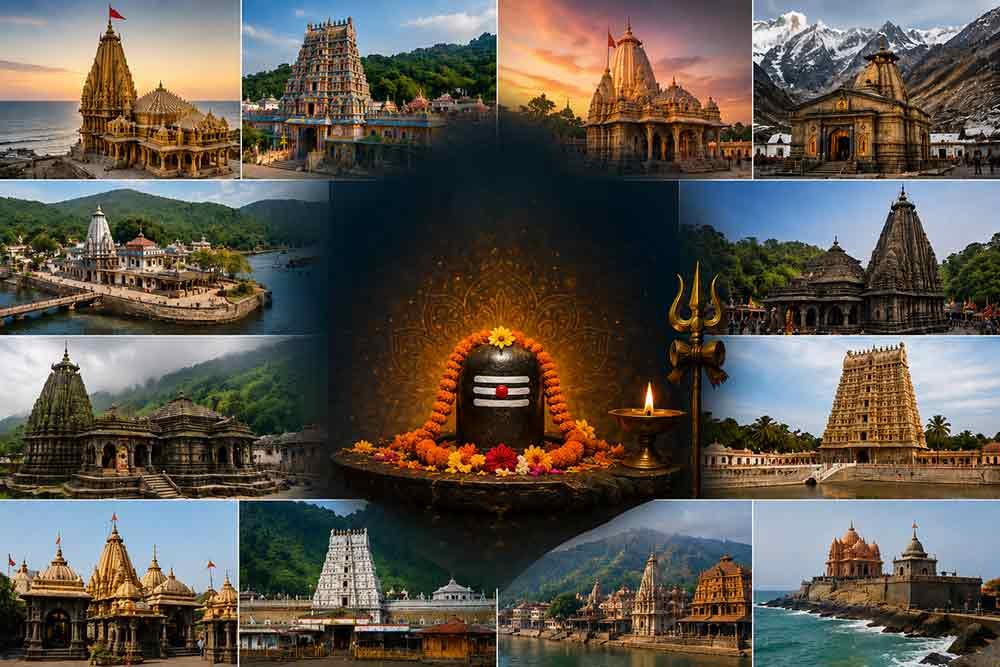
For centuries, devotees have remembered them through the Dwadash Jyotirlinga Stotra, a hymn that lists all twelve in a fixed order. It is believed that simply reciting these twelve names every morning washes away sins committed over seven lifetimes. Below is that same traditional order, with everything you need to know about each dham.
The 12 Jyotirlingas in Order
1. Somnath Jyotirlinga, Gujarat
The first Jyotirlinga stands on the Arabian Sea coast at Prabhas Patan near Veraval. Legend says the Moon God (Soma) built this temple to free himself from a curse, which is why Shiva here is Somnath, the Lord of the Moon. Destroyed and rebuilt many times through history, the temple today is a symbol of unbroken faith. The evening aarti with the sound of waves behind it is an experience in itself. Best time to visit is October to March, and Mahashivratri here is grand beyond words.
2.Mallikarjuna Jyotirlinga, Andhra Pradesh
On the Srisailam hill beside the Krishna river, Mallikarjuna is rare in a beautiful way: it is both a Jyotirlinga and a Shakti Peetha, where Shiva resides as Mallikarjuna and Parvati as Bhramaramba. The story connects it to Kartikeya, who settled here after a disagreement with his family, and Shiva and Parvati followed to be near their son. Winter months are ideal for the hill journey.
3.Mahakaleshwar Jyotirlinga, Madhya Pradesh
In the ancient city of Ujjain stands the only dakshinamukhi (south facing) Jyotirlinga. Mahakal is the lord of time and death itself, and his famous Bhasma Aarti at dawn, where the linga is adorned with sacred ash, is one of the most sought after darshans in India. Book the Bhasma Aarti well in advance. The Mahakal Lok corridor has made the darshan experience grander than ever.
4.Omkareshwar Jyotirlinga, Madhya Pradesh
Here the Narmada river splits to form an island shaped like the sacred symbol Om, and on it sits Omkareshwar. Tradition holds that after visiting all pilgrimage sites, a yatra remains incomplete until the water collected is offered here. The parikrama of the island, about 7 km on foot, is deeply peaceful. Visit between October and March.
5.Kedarnath Jyotirlinga, Uttarakhand
At 3,583 metres in the Himalayas, Kedarnath is the highest and most demanding Jyotirlinga yatra. The Pandavas are said to have sought Shiva here after the Mahabharata war, and Shiva took the form of a bull, leaving his hump at this spot. The temple opens only from around Akshaya Tritiya (April end) to Diwali, remaining snowbound the rest of the year. The 16 km trek from Gaurikund tests the body and transforms the spirit.
6.Bhimashankar Jyotirlinga, Maharashtra
Nestled in the Sahyadri hills about 110 km from Pune, Bhimashankar is where Shiva destroyed the demon Bhima, son of Kumbhakarna. The sweat that fell from Shiva’s body after the battle is said to have formed the Bhima river. Surrounded by a wildlife sanctuary and misty forests, this is the Jyotirlinga for those who find god in nature too. Monsoon turns the region into a green paradise, though the trek gets slippery.
7.Kashi Vishwanath Jyotirlinga, Uttar Pradesh
In Varanasi, the eternal city on the Ganga, resides Vishwanath, the Lord of the Universe. It is said Kashi rests on Shiva’s trishul and is never destroyed, even at the end of creation. Moksha is believed certain for those who breathe their last here. The Vishwanath corridor now connects the temple directly to the ghats. Dev Deepawali and Mahashivratri are the most magical times, though Kashi truly never has an off season.
8.Trimbakeshwar Jyotirlinga, Maharashtra
Near Nashik, at the origin of the sacred Godavari river, stands Trimbakeshwar. The linga here is unique: it has three faces representing Brahma, Vishnu and Mahesh, something found at no other Jyotirlinga. The temple is also the principal seat for Kaal Sarp Dosh and Narayan Nagbali pujas. The Kumbh Mela of Nashik centres around this dham.
9.Baidyanath Jyotirlinga, Jharkhand
In Deoghar resides Baba Baidyanath, the healer. This is the Jyotirlinga of Ravan’s devotion, where the demon king offered his own heads to Shiva, and Shiva healed him like a vaidya. Uniquely, it is both a Jyotirlinga and a Shakti Peetha, and the linga is called Kamna Linga, the fulfiller of wishes. During Sawan, the world’s longest religious fair unfolds here as lakhs of kanwariyas walk 105 km from Sultanganj carrying Ganga jal. Read our complete Sawan at Baidyanath Dham guide for the full experience.
10.Nageshwar Jyotirlinga, Gujarat
Between Gokul and Dwarka stands Nageshwar, the Lord of Serpents, who protects devotees from all poisons, physical and spiritual. The story tells of the demon Daruka who imprisoned a devotee named Supriya, whose unwavering prayers brought Shiva to destroy the demon. The towering 25 metre Shiva statue outside the temple has become an icon. Combine this darshan with the Dwarkadhish yatra.
11.Rameshwaram Jyotirlinga, Tamil Nadu
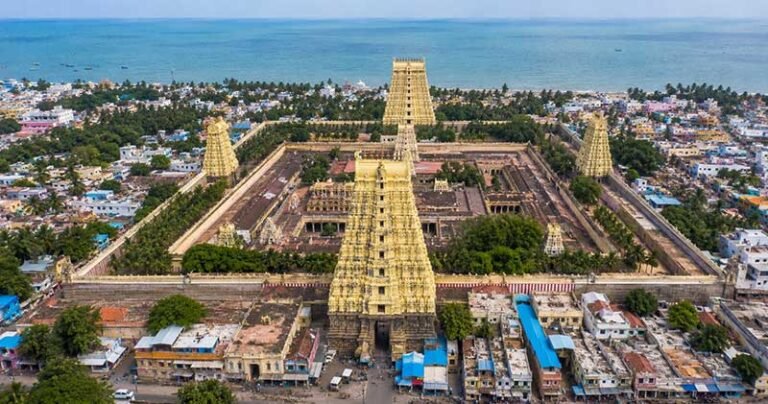
The southernmost Jyotirlinga is the one Lord Rama himself established before crossing to Lanka, seeking Shiva’s blessings. This makes Rameshwaram sacred to both Shaiva and Vaishnava traditions, and it is also one of the Char Dhams. The Ramanathaswamy temple’s third corridor is the longest temple corridor in the world, and bathing in the 22 theerthams (holy wells) inside the temple is part of the darshan tradition.
12.Grishneshwar Jyotirlinga, Maharashtra
The twelfth and final Jyotirlinga stands at Verul near the Ellora caves, about 30 km from Sambhajinagar. The story of the devotee Ghushma, whose son was restored to life by Shiva, gives this dham its name, the Lord of Compassion. It is the smallest Jyotirlinga temple in size, yet completing your yatra here carries the satisfaction of a circle closed. The Ellora caves next door make it a confluence of faith and heritage.
Planning a 12 Jyotirlinga Yatra
Covering all twelve dhams is the dream of every Shiva devotee. A few practical truths from those who have done it:
- It cannot be rushed. The twelve are spread across nine states, from the Himalayas to the southern sea. A complete yatra takes 20 to 30 days by road and rail, or can be done region by region over several trips.
- Natural clusters make it easier. Gujarat covers Somnath and Nageshwar together. Madhya Pradesh pairs Mahakaleshwar and Omkareshwar. Maharashtra alone has three: Bhimashankar, Trimbakeshwar and Grishneshwar.
- Kedarnath decides your calendar. Since it opens only from late April to Diwali, plan the Himalayan leg first and build the rest around it.
- Sawan is the most auspicious month for any Jyotirlinga darshan, though also the most crowded, especially at Baidyanath and Kashi.
We will be publishing a detailed 12 Jyotirlinga yatra route plan with budget soon. Until then, every temple above has a dedicated page on LiveDarshanHub with darshan timings, travel details and live darshan where available.
Frequently Asked Questions
What are the 12 Jyotirlingas and their states?
Somnath and Nageshwar (Gujarat), Mallikarjuna (Andhra Pradesh), Mahakaleshwar and Omkareshwar (Madhya Pradesh), Kedarnath (Uttarakhand), Bhimashankar, Trimbakeshwar and Grishneshwar (Maharashtra), Kashi Vishwanath (Uttar Pradesh), Baidyanath (Jharkhand) and Rameshwaram (Tamil Nadu).
What is the correct order of the 12 Jyotirlingas?
As per the Dwadash Jyotirlinga Stotra: Somnath, Mallikarjuna, Mahakaleshwar, Omkareshwar, Kedarnath, Bhimashankar, Kashi Vishwanath, Trimbakeshwar, Baidyanath, Nageshwar, Rameshwaram and Grishneshwar.
Which Jyotirlinga should I visit first?
Tradition begins with Somnath, the first in the stotra. Practically, devotees often start with whichever dham is nearest and complete the rest in regional clusters.
Can all 12 Jyotirlingas be visited in one trip?
Yes, but it requires 20 to 30 days. Most devotees complete the yatra in 3 to 4 regional trips spread over one or two years.
Which is the most difficult Jyotirlinga to reach?
Kedarnath, which requires a 16 km Himalayan trek from Gaurikund and remains open only about six months a year. Helicopter services are available for those unable to trek.
What is the benefit of reciting the 12 Jyotirlinga names?
According to the Shiva Purana, reciting the Dwadash Jyotirlinga Stotra every morning and evening cleanses the sins of seven births and brings the devotee closer to Shiva.
Har Har Mahadev! Bookmark this page as your companion for the Jyotirlinga yatra, and visit the live darshan page of any dham on LiveDarshanHub to begin every morning with Mahadev’s darshan, wherever you are.