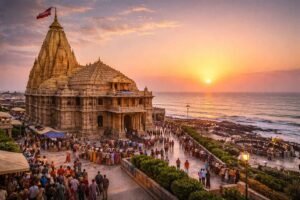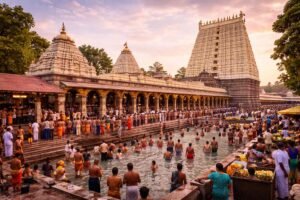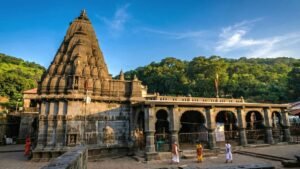
📜 About Mallikarjuna Jyotirlinga Temple
Introduction — Kailash of the South
Mallikarjuna Temple at Srisailam is one of the most extraordinary pilgrimage sites in India. It holds the unique distinction of being simultaneously the second Jyotirlinga of Lord Shiva and one of the 18 Maha Shakti Peethas of Goddess Bhramaramba, a combination found at only a handful of places in the entire subcontinent. Perched majestically on the Srisailam plateau in the Nallamala Hills of Andhra Pradesh, on the banks of the sacred Krishna River, this temple complex is a divine confluence of Shaiva and Shakta traditions.
The presiding deity Lord Shiva is worshipped here as Mallikarjuna, a name combining Mallika (Jasmine flower, representing Goddess Parvati) and Arjuna (white/pure, representing Lord Shiva). The Goddess is worshipped as Bhramaramba, the divine mother who took the form of a swarm of bees (Bhramar) to slay the demon Arunasura. Together, Mallikarjuna and Bhramaramba form a divine couple that blesses all devotees who climb these sacred hills.
The Srisailam temple complex is also known as “Sikharam” in the Shiva Purana, and it is mentioned that a mere sight of this mountain is enough to grant liberation. The Srisailam hills, with their dense Nallamala forest, the roaring Krishna River below, and the ancient stone temple at the summit, create an atmosphere of profound peace and divine power that is unlike any other place in southern India.
Mythological Origin & Significance
The mythology of Mallikarjuna Jyotirlinga is deeply connected to the story of Lord Ganesha’s marriage and Lord Kartikeya’s (Murugan’s) displeasure. According to the Shiva Purana, when the question of who should marry first arose between Ganesha and Kartikeya, Lord Shiva declared that whoever circumambulates the earth first would be married first. Kartikeya immediately set off on his peacock to circle the earth. Ganesha, understanding the deeper spiritual meaning, simply circumambulated his parents Shiva and Parvati — declaring them to be the entire universe. Ganesha was thus married first.
Furious at this outcome, Kartikeya left Mount Kailash and went to the Krauncha mountain (present-day Srisailam hill). Shiva and Parvati, grieving at the separation from their beloved son, came to Srisailam on every Amavasya (new moon night) and Purnima (full moon night) to visit Kartikeya. Though Kartikeya refused to meet them, he would move to another nearby mountain. Seeing the infinite love of his parents, Kartikeya finally relented. Lord Shiva and Parvati, in the forms of Mallikarjuna and Bhramaramba, then chose to permanently reside on this sacred hill, blessing all devotees who come here.
Another legend states that a princess named Chandravati, a devout shepherdess, discovered that her cow was miraculously giving milk to a Shivalinga hidden beneath a Jasmine (Mallika) tree. She informed the king, who ordered the construction of the first temple at this spot. Since the Shivalinga was found beneath a Jasmine tree (Mallika) and Arjuna trees surrounded it, the deity came to be called Mallikarjuna.
The Skanda Purana devotes an entire chapter (Srisaila Khanda) to the glory of Srisailam, declaring that bathing in the Krishna River at the base of Srisailam hill and having darshan of Mallikarjuna grants liberation equivalent to a thousand Ashwamedha Yagnas. The Mahabharata also references Srisailam as one of the holiest tirthas.
History of the Temple
Srisailam is one of the oldest continuously worshipped temple sites in India. Inscriptions found at the site date back to the 2nd century BC, indicating that this was a sacred site even before the Common Era. The earliest references to the temple appear in the Mahabharata and various Puranas.
Ancient and Medieval Period
The temple received royal patronage from some of the greatest dynasties of South India. The Satavahana dynasty (2nd century BC – 3rd century AD) is credited with early construction activities at the site. The Ikshvaku kings, the Pallava rulers, and the Rashtrakutas all contributed to the development of the temple complex. The great philosopher Adi Shankaracharya visited Srisailam in the 8th century AD and composed the famous hymn Shivananda Lahari here, one of the most beautiful devotional compositions in Sanskrit literature.
The Kakatiya dynasty (12th–14th century) made significant contributions to the temple, constructing the outer walls and the imposing gateway towers (gopurams). The Vijayanagara Empire, particularly Emperor Harihara II and later Krishnadevaraya, lavishly expanded and decorated the temple complex in the 15th and 16th centuries. Krishnadevaraya is credited with building the magnificent Mukha Mandapam and donating enormous wealth to the temple.
The Reddi Kings and Later Rulers
The Reddi kings of Kondavidu were great patrons of Srisailam, building several mandapams and ensuring the continuous conduct of rituals. The Qutb Shahi rulers of Golconda also patronized the temple despite being Muslim rulers, recognizing its immense regional importance. After the decline of the Vijayanagara empire, the Nawabs of Hyderabad and later the Nizam government maintained the temple.
Modern Era
After Indian Independence, the Andhra Pradesh government took over the management of the temple through the Srisaila Devasthanam Trust. The construction of the Srisailam Dam (one of the largest hydroelectric projects in India) on the Krishna River in the 1980s brought modern infrastructure to the region, making the previously inaccessible hilltop shrine more accessible to pilgrims. Today, the temple is one of the most visited pilgrimage sites in Andhra Pradesh.
Architecture
The Mallikarjuna Temple is a stunning example of Dravidian architecture, with elements of the Vijayanagara style. The massive temple complex spreads over a large area and features:
- Main Gopuram (East Gate Tower): The towering eastern gateway, over 9 stories tall, intricately carved with hundreds of divine figures, is the most iconic feature of the temple
- Shikhara: The main tower over the sanctum rises impressively above the Nallamala forest canopy
- Mukha Mandapam: Built by Krishnadevaraya, a grand pillared hall with exquisite carvings
- Sahasra Linga Mandapam: A hall with 1,000 Shivalingas carved on the walls and pillars
- Patala Ganga Ghat: The sacred ghats at the base of the hill on the Krishna River, accessible by a ropeway
- Bhramaramba Shrine: Separate shrine for the Goddess within the temple complex
- Fortified Outer Walls: Massive stone walls built during the Kakatiya period enclosing the entire temple complex
The entire complex is surrounded by lush Nallamala forest, dense with medicinal plants and wildlife, which adds to the mystical atmosphere. The temple faces east, and during certain times of the year, the first rays of the sunrise fall directly on the Shivalinga.
The Sacred Patala Ganga
At the base of the Srisailam hill, the Krishna River flows through a dramatic gorge, this sacred stretch of the river is called Patala Ganga. A dip in Patala Ganga before darshan is considered essential and equivalent to bathing in all the sacred rivers of India combined. A modern ropeway connects the hilltop temple to the Patala Ganga ghats, offering a breathtaking aerial view of the Nallamala forest and the Krishna River below. The sight from the ropeway — the vast forest, the deep gorge, and the glittering river, is one of the most spectacular views in all of South India.
Shakti Peetha Goddess Bhramaramba
Srisailam is one of the 18 Maha Shakti Peethas, where the neck of Goddess Sati is believed to have fallen after Lord Vishnu severed her body with his Sudarshana Chakra to end Lord Shiva’s grief. The Goddess manifested here as Bhramaramba — a form where she took the appearance of a swarm of black bees (Bhramar) to destroy the demon Arunasura, who had obtained a boon that he could not be killed by any weapon but could be killed by a swarm of insects. Bhramaramba Devi is worshipped separately in her own shrine within the temple complex, and her power is believed to be equal to that of Mallikarjuna himself.
Aarti & Daily Rituals
The rituals at Mallikarjuna Temple follow a meticulous daily schedule. The day begins with Suprabhatam (early morning awakening of the deity) before sunrise, followed by the ceremonial bath of the Shivalinga with panchamrit, milk, and sacred water from the Krishna River. Six main aartis are performed throughout the day:
- Suprabhatam: Pre-dawn awakening prayer
- Viswarupam: Morning darshan with special decoration
- Asthadala Pada Padmaradhana: Mid-morning ritual
- Madhyanha Aarti: Noon aarti
- Pradosha Aarti: Evening aarti at sunset
- Ekanta Seva: Night prayer before the deity retires
On Mondays, Shivaratris, and during Shravan month, special extended rituals are conducted with thousands of devotees participating in the abhishek.
Major Festivals
- Maha Shivaratri: The grandest festival, celebrated for multiple days with hundreds of thousands of pilgrims
- Ugadi (Telugu New Year): Massive fair and special puja at Srisailam
- Karthika Masam (Karthik Month): Month-long special rituals and deepotsavam (festival of lights)
- Shravan Month: Special pujas every Monday; heavy pilgrim footfall
- Brahmotsavam: Annual 9-day grand festival with elaborate processions and rituals
- Navaratri: Nine-day festival dedicated to Goddess Bhramaramba
How to Reach Srisailam
By Air: The nearest airport is Rajiv Gandhi International Airport, Hyderabad (212 km). From Hyderabad, taxis and buses are available to Srisailam.
By Train: The nearest railway station is Markapur Road (85 km) or Kurnool (170 km). From both stations, taxis and buses connect to Srisailam.
By Road: Srisailam is well connected to Hyderabad (212 km), Kurnool (170 km), Nandyal (100 km), and Vijayawada (280 km). APSRTC buses run regularly from all major cities. The road through the Nallamala forest is scenic but has restricted night travel due to wildlife.
Nearby Attractions
- Patala Ganga Ghats — Sacred Krishna River ghats at the base of the hill
- Srisailam Dam — One of India’s largest hydroelectric dams, stunning view
- Akkamahadevi Caves — Ancient caves with Shivalingas, named after the saint-poet
- Nagarjunasagar Dam (100 km) — Massive dam and reservoir
- Nallamala Forest — Rich wildlife sanctuary with tigers, leopards, and rare flora
- Hatakeshwara Temple — Ancient temple within the Srisailam complex
- Sakshi Ganapati Temple — Must-visit Ganesha temple near the main entrance
Spiritual Importance
The Shiva Purana states that a visit to Srisailam grants liberation (moksha) equivalent to performing a thousand Ashwamedha Yagnas. The mere sight of the Srisailam mountain is said to destroy all sins. For devotees of both Shiva and Shakti traditions, Srisailam holds a uniquely elevated status, it is one of the very few places in India where a Jyotirlinga and a Shakti Peetha are present at the same location. This dual sanctity is believed to multiply the spiritual merit of a pilgrimage here manifold. Pilgrims who complete a Pradakshina (circumambulation) of the entire Srisailam hill, a journey of approximately 125 km through the forest, are said to attain extraordinary spiritual merit.
🗿 Temple Murti / Statue
मल्लिकार्जुन ज्योतिर्लिंग — श्रीशैलम, आंध्र प्रदेश
Darshan & Aarti Timings
🚪 Darshan Timings
🪔 Aarti Schedule
⭐ Best Time to Visit
⚠️ Timings may change on festivals, special occasions, or during temple renovation. Please verify with the temple before visiting.
Visitor Information
🗺️ Location & How to Reach
Rajiv Gandhi International Airport, Hyderabad (212 km)
Markapur Road (85 km) | Kurnool (170 km)
risailam Bus Stand (at temple)