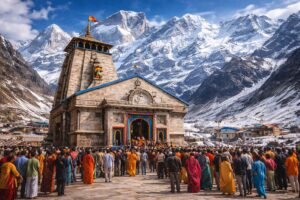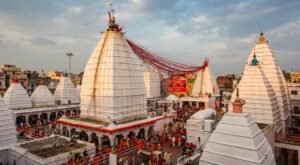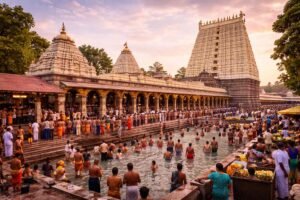
📜 About Kashi Vishwanath Jyotirlinga
Varanasi — The City That Never Lets Go
There is a reason why every Hindu, in the deepest part of their heart, wants to die in Varanasi. It is not morbidity. It is theology wrapped in love. The belief is this: if you die in Kashi, Lord Shiva himself whispers the Taraka Mantra, the mantra of liberation, into your ear at the moment of death. You bypass the wheel of rebirth entirely. You go straight to moksha. This is why, for thousands of years, the elderly, the ill, the dying have made their way to Varanasi, to spend their final days in the city of Shiva, to have their bodies cremated on the banks of the Ganga at Manikarnika Ghat, and to be liberated.
The Ganga at Varanasi flows from south to north, which is geographically unusual and spiritually significant. Northward-flowing rivers are considered especially auspicious in Hindu tradition. The city itself sits on the western bank, so the rising sun illuminates it from the east across the river, turning the ghats gold every morning in a display that has inspired poets, painters, and pilgrims for millennia.
And at the center of all of this, the cremation fires, the morning aartis, the thousands of pilgrims, the saddhus, the temples, the chai shops, the centuries of accumulated prayer, is Kashi Vishwanath. The Lord of Kashi. The Lord of the Universe. The seventh and perhaps the most emotionally overwhelming of all the Jyotirlingas.
The Golden Temple — What Those Spires Mean
If you approach Kashi Vishwanath from the river, which is the most beautiful way to arrive, floating past the ghats in a wooden boat as the city wakes up, you will see, rising above the rooftops of the old city, two spires sheathed entirely in gold. 1,000 kilograms of pure gold, donated by Maharaja Ranjit Singh of Punjab in 1835. The gold catches the morning light and throws it back across the river. On a clear day, you can see the gleam from kilometres away.
But here is what those gold spires really mean. They are not decoration. They are a declaration. A declaration that was made, and remade, and made again across centuries of destruction and rebuilding, the same defiant declaration every time: Shiva is here. Shiva has always been here. And no force in the universe will change that.
The temple has been destroyed and rebuilt at least three times. The most devastating destruction was by Aurangzeb in 1669, who demolished the original temple and built the Gyanvapi Mosque on its site, a wound that has never fully healed in the Hindu consciousness. The current temple was built in 1780 by Maharani Ahilyabai Holkar of Indore, the same extraordinary queen who also restored temples at Somnath, Omkareshwar, and dozens of other sacred sites across India. Then Ranjit Singh added the gold. Then, in 2021, Prime Minister Narendra Modi inaugurated the magnificent Kashi Vishwanath Corridor, a grand redevelopment that transformed the area around the temple, connecting it directly to the Ganga ghats and giving it a dignity and spaciousness it had been denied for centuries.
The Mythology — Why Shiva Called This His Favourite City
Ask any Hindu scholar which city Lord Shiva loves most and the answer is immediate: Kashi. Not Kailash, where he lives. Not the battlegrounds where he fights demons. Kashi. The city of light, learning, and liberation.
According to the Skanda Purana and Kashi Khanda, Kashi was the very first land to emerge when Lord Shiva and Parvati created the universe. It is said that Kashi exists outside the normal cycle of creation and destruction; it is Anadi (without beginning) and Ananta (without end). When the universe is dissolved at the end of a cosmic cycle, Kashi alone remains, held aloft on Lord Shiva’s trident, safe from the waters of dissolution. When a new universe begins, Kashi is the first land to be set down.
The name Kashi comes from the Sanskrit root kas, to shine, to radiate light. Kashi is the city of light, not the physical light of lamps and fire (though there is plenty of that too), but the divine inner light of consciousness. The Jyotirlinga here is called Vishwanath, Vishwa (universe) + Nath (Lord), the Lord of the entire Universe. Every other Jyotirlinga is the Lord of its region, its mountain, its river. Vishwanath alone is the Lord of everything.
The Kashi Khanda of the Skanda Purana contains 11,000 verses dedicated entirely to the glory of Kashi and Vishwanath. It says that even the mention of Kashi’s name in any context, whether in joy or sorrow, whether in prayer or in casual conversation, grants merit. That is the power this city has accumulated over uncountable millennia of prayer, death, and rebirth.
The Temple Today — Old City, New Corridor, Eternal God
The old Kashi Vishwanath Temple, before the Corridor was built, was famous for being almost impossible to reach. The temple sat deep inside the old city’s galis (lanes), accessible only through a maze of narrow alleyways barely wide enough for two people to pass. You navigated by instinct, by smell of camphor and marigolds, by the sound of bells getting louder. It was chaotic, crowded, occasionally overwhelming, and utterly magical.
The Kashi Vishwanath Corridor, inaugurated in December 2021, changed this, but more carefully than critics feared. The corridor created a grand 50-metre-wide promenade connecting Lalita Ghat on the Ganga directly to the temple entrance, demolishing hundreds of encroachments that had grown up around the temple over centuries. From the new corridor, you can now see both the temple’s golden spires AND the Ganga from the same vantage point, a view that was hidden for hundreds of years. The complex now includes temples, mandapams, galleries, a museum, and facilities for pilgrims, spread across 5 lakh square feet.
The old alleyways still exist, you can still get wonderfully lost in them, but now there is also a dignified, spacious approach for the millions who come every year.
The Jyotirlinga — What You Experience Inside
The main sanctum of Kashi Vishwanath is small. Surprisingly, disarmingly small, given the cosmic weight of what is worshipped here. The Vishwanath Jyotirlinga stands in a silver-encased pit, about 60 cm tall, adorned with flowers, bel leaves, and sacred ash. The walls of the inner sanctum are plated in silver. The ceiling above the linga is silver. The lamps burn constantly. The fragrance of camphor and sandalwood is overwhelming in the best possible way.
When you finally stand before the linga, after all the queuing, all the security checks, all the crowds, there is a moment of complete silence inside you. The noise of the city, the noise of your own thoughts, drops away. What remains is something very old and very still. Whatever name you give it, God, consciousness, Shiva, the universe, it doesn’t matter. Something answers.
That is Kashi Vishwanath. That is the seventh Jyotirlinga.
The Ganga Aarti — Kashi’s Greatest Daily Spectacle
You cannot come to Varanasi and not witness the Ganga Aarti at Dashashwamedh Ghat. Every single evening, as the sun sets over the river, eleven young priests in identical ochre robes take their positions on the stone platform at the ghat. They hold massive, multi-tiered brass lamps, each with dozens of burning wicks. As the conches blow and the drums begin and the bells ring, they begin the aarti in perfect unison: an intricate, choreographed ritual of light, fire, and prayer that goes on for 45 minutes.
The crowd that gathers, on the ghat, in boats on the river, on every available inch of stone, is enormous. Yet somehow, the aarti creates a bubble of stillness around each person who watches it. People cry. People sit in stunned silence. Tourists from countries that have never heard of Shiva or the Ganga find themselves moved in ways they cannot explain. There is something universal happening at Dashashwamedh Ghat every evening, a conversation between humans and whatever it is that lies beyond them.
Go early to get a good spot on the ghat. Or hire a boat and watch from the river. Either way, go.
The Ghats of Varanasi — A City’s Soul Made of Stone Steps
Varanasi has 88 ghats, stone staircases that descend from the city into the Ganga, each with its own history, its own deity, its own character. Walking the ghats from Assi Ghat in the south to Raj Ghat in the north is one of the great walks of the world. Along the way you pass:
- Assi Ghat, Where the Assi River meets the Ganga; popular for the morning Shiva puja under the Peepal tree
- Tulsi Ghat — Where the poet-saint Tulsidas wrote the Ramcharitmanas
- Harishchandra Ghat — One of two cremation ghats; burning continuously for millennia
- Dashashwamedh Ghat — The most famous ghat; site of the daily Ganga Aarti
- Man Mandir Ghat — With the beautiful observatory of Raja Man Singh
- Manikarnika Ghat — The great cremation ghat; fires have burned here without interruption for at least 3,500 years. This is where Shiva whispers the Taraka Mantra.
- Scindia Ghat — With its partially submerged Shiva temple, slowly sinking into the Ganga
- Lalita Ghat — Now connected directly to Kashi Vishwanath via the new Corridor
Aarti & Daily Rituals at Kashi Vishwanath
The Kashi Vishwanath Temple conducts five major aartis every day, following a tradition that has continued, without interruption, for centuries:
- Mangala Aarti: 3:00 AM — The most sacred aarti, performed in the pre-dawn hours when the city is still and the divine presence is said to be most accessible. Limited entry; extremely powerful experience.
- Bhog Aarti: 11:15 AM — Morning food offering to the deity
- Sandhya Aarti: 7:00 PM — Evening aarti as the city lights up
- Shringar Aarti: 9:00 PM — Royal decoration of the deity with fresh ornaments and flowers
- Shayan Aarti: 10:30 PM — Final night aarti before the Lord rests
Each aarti has a specific dress code, timing, and ritual, and each draws a different kind of devotee. The 3 AM Mangala Aarti is for the serious pilgrim who wakes before the city does. The Shringar Aarti at 9 PM is when the deity is at his most beautiful, dressed like a king, surrounded by flowers, alive in lamplight.
Major Festivals in Kashi
- Maha Shivaratri: The grandest night in Kashi — the entire city stays awake, processions wind through every gali, and Vishwanath receives non-stop darshan from midnight to dawn. One of the most extraordinary religious experiences in India.
- Dev Deepawali (Kartik Purnima): Fifteen days after Diwali, every ghat in Varanasi is illuminated with lakhs of earthen lamps. The Ganga reflects a million flames. This festival — largely unknown outside UP — is perhaps the most visually spectacular night of the year anywhere in India.
- Shravan Month: The holiest month for Shiva — Kanwariyas from across North India carry Ganga water to Varanasi and beyond; special abhisheks daily
- Diwali: The entire city goes electric with lamps and firecrackers; the ghats are alive all night
- Nag Panchami, Navratri, Holi: All celebrated with extraordinary energy in Kashi
- Ganga Mahotsav: Annual five-day classical music and culture festival on the ghats
How to Reach Varanasi
By Air: Lal Bahadur Shastri International Airport, Varanasi (26 km from the temple) has direct flights from Delhi, Mumbai, Kolkata, Bengaluru, Hyderabad, and several other cities. The airport has seen massive expansion in recent years.
By Train: Varanasi Junction and Manduadih (Banaras) Station are among the busiest railway junctions in India, connected to virtually every major city. The Kashi Express, Mahanagari Express, Vande Bharat Express are popular trains from Delhi and Mumbai.
By Road: Varanasi is connected via NH-19 (Delhi-Kolkata highway). About 320 km from Lucknow, 400 km from Allahabad (Prayagraj), 800 km from Delhi. Regular buses from Lucknow, Allahabad, Gorakhpur, and Agra.
Essential Tips for Kashi Vishwanath Darshan
- 📱 Online booking: Temple pass and special darshan slots can be booked at kashivishwanath.in — strongly recommended to avoid long queues
- 🔒 Security: No mobile phones, cameras, leather items, or large bags allowed inside the temple. Lockers available outside.
- 👗 Dress code: Traditional — dhoti/kurta for men, saree/salwar for women. No shorts, sleeveless, or torn clothing.
- ⏰ Best time for darshan: Weekday mornings (Tuesday and Saturday see highest crowds). Mangala Aarti at 3 AM for an experience unlike any other.
- 🚶 Walking the ghats: Start at Assi Ghat at sunrise, walk north along the ghats. Best 2–3 hour experience in Varanasi.
- 🛶 Boat ride: Take a rowing boat at dawn to see the ghats from the river. Non-negotiable.
- 🍵 Try the local: Banarasi paan, thandai, kachori-sabzi for breakfast near the ghats. These are not optional.
Nearby Attractions
- Dashashwamedh Ghat — Ganga Aarti every evening; don’t miss it
- Manikarnika Ghat — The great cremation ghat; approach respectfully
- Sarnath (13 km) — Where the Buddha gave his first sermon; Dhamek Stupa and Ashoka Pillar
- Gyanvapi Mosque — Built on the site of the original Vishwanath Temple; complex history
- Banaras Hindu University (BHU) — The stunning New Vishwanath Temple inside campus
- Ramnagar Fort (across the river) — Palace of the Maharaja of Varanasi
- Tulsi Manas Temple — Where Tulsidas wrote the Ramcharitmanas
- Sankat Mochan Temple — Beloved Hanuman temple; extremely important to locals
Why Kashi Is Different From Every Other Place on Earth
People ask sometimes: why does Varanasi feel so different? Why does it feel older than time, more alive than anywhere else, simultaneously the most chaotic and the most peaceful city in the world?
The answer might be this: Varanasi is the only city in the world that has made peace with death. While every other city pretends death isn’t happening, hiding it in hospitals and mortuaries and polite silences, Varanasi puts it on the river, in the open, in fire, in full view. The burning ghats are not hidden. They are the centre of the city. And because death is not denied, life in Varanasi has an intensity, a vividness, an aliveness that is available nowhere else.
Lord Shiva, who smears himself in cremation ash, who lives in the cremation ground, who is both the destroyer and the ultimate liberator, could have chosen any city in the universe. He chose this one. The city that looks death in the eye and keeps dancing.
Come to Kashi. Stand before Vishwanath. Let the city do what it does to everyone who stays long enough.
It will break you open. And then it will put you back together differently.
🗿 Temple Murti / Statue
काशी विश्वनाथ ज्योतिर्लिंग — ब्रह्मांड के स्वामी, वाराणसी
Darshan & Aarti Timings
🚪 Darshan Timings
🪔 Aarti Schedule
⭐ Best Time to Visit
⚠️ Timings may change on festivals, special occasions, or during temple renovation. Please verify with the temple before visiting.
Visitor Information
🗺️ Location & How to Reach
Lal Bahadur Shastri International Airport, Varanasi (26 km)
Varanasi Junction (3 km) | Manduadih/Banaras Station (5 km)
Varanasi Bus Stand (4 km)