📜 About Omkareshwar Jyotirlinga Temple
Introduction — The Island of Om
Omkareshwar, one of the most visually stunning pilgrimage sites in India, is located on the sacred island of Mandhata in the Narmada River, near Khandwa in Madhya Pradesh. What makes this site extraordinarily unique is the shape of the island itself when viewed from above, the entire island, formed by the bifurcation of the Narmada River, takes the perfect shape of the sacred Hindu symbol Om (ॐ). This divine geographical formation has drawn sages, saints, and pilgrims to this island for thousands of years, believing it to be a spot where the sacred vibration of Om resonates eternally through the earth, water, and air.
The name Omkareshwar is derived from Omkar (the sacred sound Om, the primordial sound of creation) and Ishwar (Lord/God), meaning “Lord of Om” or “The God Who is Om Himself.” This is deeply significant in Hindu philosophy, where Om is considered the very first sound that emerged from the universe at the moment of creation, the sound of Brahman (the Absolute). Lord Shiva, who is himself the embodiment of Om, chose to reside permanently on this Om-shaped island, making it one of the most cosmically charged pilgrimage destinations on earth.
The Narmada River, which cradles this sacred island, is itself one of the most holy rivers in Hinduism. Unlike most sacred rivers, the Narmada is worshipped not by bathing in it but by completing a Parikrama (circumambulation) of its entire length, approximately 2,600 km, a pilgrimage that takes 3 years to complete on foot. The Narmada is believed to be so pure that even its sight, sound, and touch grants liberation. The combination of the Om-shaped island and the holy Narmada creates a spiritual atmosphere at Omkareshwar that is profound and unmatchable.
The Two Jyotirlingas, Omkareshwar & Amareshwar
Omkareshwar is unique among all Jyotirlinga sites because two Jyotirlingas are present here, not one. The Shiva Purana lists both Omkareshwar and Amareshwar (also called Mamleshwar) as separate Jyotirlingas, making this location the only place in India where two of the twelve Jyotirlingas exist at the same site.
- Omkareshwar Jyotirlinga: Located on the Mandhata island, in the main Omkareshwar temple at the top of the hill. This is the primary Jyotirlinga worshipped on the island.
- Amareshwar (Mamleshwar) Jyotirlinga: Located on the south bank of the Narmada River, directly across from the island. This ancient temple is equally sacred and is counted as the fourth Jyotirlinga by some Puranic traditions while others count it as the same as Omkareshwar.
A complete pilgrimage to Omkareshwar involves visiting both temples, taking a dip in the Narmada, and completing the Parikrama (circumambulation) of the Mandhata island, approximately 7 km on foot.
Mythological Origin & Significance
The mythology of Omkareshwar Jyotirlinga is beautifully narrated in the Shiva Purana and Skanda Purana. There are two primary legends associated with this sacred site.
Legend of the Vindhya Mountain
According to the Shiva Purana, the Vindhya Mountain (the great mountain range of central India) once performed intense penance (tapasya) to Lord Shiva, desiring to become the greatest mountain in the universe, surpassing even Mount Meru (the cosmic mountain). Vindhya fasted, prayed, and worshipped a clay (parthiv) Shivalinga on the banks of the Narmada River for a very long time. Pleased by this extraordinary devotion, Lord Shiva appeared before Vindhya and asked him what he desired. Vindhya requested great height and glory. Lord Shiva granted the boon but counseled humility. At this time, all the assembled gods and sages also prayed to Lord Shiva to remain permanently at this sacred spot for the benefit of all devotees. Lord Shiva agreed, and the divine Jyotirlinga established itself here, henceforth known as Omkareshwar.
Legend of the Battle Between Gods and Demons
Another legend describes a great battle between the Devas (gods) and Danavas (demons). The demons defeated the gods and occupied the three worlds. The defeated gods went to Mount Meru and prayed intensely to Lord Shiva. Shiva appeared in a blazing form and destroyed the demons, restoring the cosmic order. The gods then prayed to Shiva to establish himself permanently at the Om-shaped island in the Narmada so that all devotees could receive his blessings for eternity. Shiva agreed, and thus Omkareshwar was established.
Connection to Adi Shankaracharya
Omkareshwar holds a supremely important place in the life of Adi Shankaracharya, the great 8th-century philosopher and reformer of Hinduism. According to tradition, Shankaracharya came to Omkareshwar as a young boy of 8 years and met his guru Govinda Bhagavatpada in a cave on the banks of the Narmada near Omkareshwar. It was here that Shankaracharya received initiation into the Advaita Vedanta philosophy that he would later propagate across India. The cave where Govinda Bhagavatpada lived is still revered on the Narmada banks near the temple. Omkareshwar is thus the birthplace of the Advaita Vedanta tradition as we know it today.
History of the Temple
The worship of Omkareshwar dates back to prehistoric times. The earliest literary references appear in the Puranas and the Mahabharata, indicating that this was a major pilgrimage site well before the Common Era.
Ancient and Medieval Period
The Mandhata island has been inhabited and worshipped since ancient times. The Paramara dynasty of Malwa (9th–13th century) were great patrons of Omkareshwar, building and maintaining the temple complex. The current temple structure shows architectural elements from the 10th–12th century, with later additions from the Maratha period. The temple was damaged during medieval Muslim invasions but was repeatedly restored by Hindu rulers.
Maratha Period
The Holkar dynasty of Indore, particularly Queen Ahilyabai Holkar (one of the greatest patrons of Hindu temples in Indian history), made significant contributions to the Omkareshwar temple complex in the 18th century. Ahilyabai Holkar renovated and supported dozens of major temples across India, and Omkareshwar was among her most important projects.
Omkareshwar Dam
In 2007, the Omkareshwar Dam was constructed on the Narmada River, raising the water level significantly around the Mandhata island. This required significant relocation of people from nearby villages and altered the landscape around the temple. However, the island and the temple complex remain intact and accessible, and the backwaters of the dam have in some ways enhanced the scenic beauty around the sacred island.
Architecture
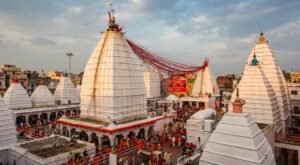
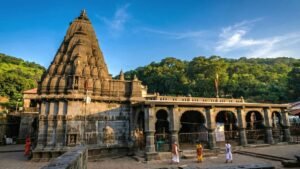
The Omkareshwar Temple on the Mandhata island is a beautiful example of Nagara (North Indian) style architecture with elements of the Bhumija style. Key architectural features:
- Main Shikhara: The towering spire above the sanctum, built in the Nagara style with intricate carvings
- Five-story Structure: The temple rises in five stories, each housing different deities
- Garbhagriha: The inner sanctum with the Omkareshwar Jyotirlinga
- Narmada Ghats: Beautiful stone ghats along the river on all sides of the island
- 24 Avatars of Vishnu: Carvings of the 24 avatars of Lord Vishnu on the outer walls
- Saptamatrika Shrine: Shrine of the Seven Divine Mothers within the complex
- Caves and Ashrams: Numerous ancient caves and ashrams of saints along the riverbanks
The Sacred Narmada Parikrama
The Narmada Parikrama, the circumambulation of the entire Narmada River from its source at Amarkantak to the sea at Bharuch and back, is considered one of the most sacred and difficult pilgrimages in Hinduism. The complete Parikrama covers approximately 2,600 km and takes 3 years to complete on foot. Pilgrims walk the south bank from the source to the sea, cross the river, and walk back along the north bank. Omkareshwar, located near the midpoint of the Narmada, is the most important stopover on this pilgrimage. A mini Parikrama of just the Mandhata island (7 km) is performed by most pilgrims who visit Omkareshwar, and is considered highly meritorious.
Aarti & Daily Rituals
The Omkareshwar Temple follows a daily ritual schedule with five main aartis:
- Bhasma Aarti (Suprabhatam): 5:30 AM — pre-dawn awakening with sacred ash
- Bhog Aarti: 8:30 AM — morning offering
- Madhyanha Aarti: 12:30 PM — midday aarti
- Sandhya Aarti: 6:30 PM — evening aarti at sunset
- Shayan Aarti: 8:30 PM — night aarti before the deity rests
On Mondays and during Shravan month, extended rituals with elaborate abhishek are performed. The Narmada Aarti at the river ghats, performed every evening, is a spectacular and deeply moving experience.
Major Festivals
- Maha Shivaratri: The biggest festival — hundreds of thousands of pilgrims, all-night puja
- Shravan Month: Month-long special rituals, Kanwar Yatra, and abhishek every Monday
- Kartik Purnima: Sacred dip in Narmada and grand fair
- Makar Sankranti: Mass holy dip at Narmada ghats
- Navratri: Nine-day special pujas and cultural programs
- Narmada Jayanti: Birth anniversary of the Narmada River — celebrated with great devotion
How to Reach Omkareshwar
By Air: Nearest airport is Devi Ahilyabai Holkar Airport, Indore (77 km). Taxis and buses available to Omkareshwar from Indore.
By Train: Nearest railway station is Omkareshwar Road Station (12 km from temple) on the Ratlam-Khandwa line. From the station, autos and taxis reach the temple.
By Road: Omkareshwar is 77 km from Indore, 140 km from Ujjain, and 307 km from Bhopal. Regular buses from Indore and Ujjain. From the mainland, pilgrims cross to the island by boat or the road bridge.
Nearby Attractions
- Mamleshwar (Amareshwar) Temple — Second Jyotirlinga, on the south bank across the river
- Govinda Bhagavatpada Cave — Cave of Adi Shankaracharya’s guru on the Narmada banks
- Siddhanath Temple — Ancient 10th-century temple with superb carvings on the island
- Omkareshwar Dam — Scenic dam view and backwaters
- Kedareshwar Temple — Ancient Shiva temple within the island complex
- Mahakaleshwar Ujjain (140 km) — Third Jyotirlinga
- Maheshwar (60 km) — Historic fort and Ahilyabai Holkar’s palace on the Narmada
- Mandu (65 km) — Medieval fortress city with stunning architecture
Spiritual Importance
The Shiva Purana declares: “He who visits Omkareshwar and bathes in the sacred Narmada is freed from all sins and attains the supreme abode of Shiva.” The Om-shaped island is believed to be a natural yantra (sacred geometric diagram) through which cosmic energy flows constantly. Meditating at Omkareshwar, particularly near the Jyotirlinga or on the banks of the Narmada, is said to accelerate spiritual progress dramatically. For devotees of Advaita Vedanta, Omkareshwar holds additional significance as the sacred ground where Adi Shankaracharya received the knowledge that would transform Indian philosophy forever. The Narmada itself is believed to grant liberation to all who touch her waters — making a pilgrimage to Omkareshwar an experience of extraordinary spiritual power on multiple levels.
🗿 Temple Murti / Statue
ओंकारेश्वर ज्योतिर्लिंग — मान्धाता द्वीप, नर्मदा नदी, मध्य प्रदेश
Darshan & Aarti Timings
🚪 Darshan Timings
🪔 Aarti Schedule
⭐ Best Time to Visit
⚠️ Timings may change on festivals, special occasions, or during temple renovation. Please verify with the temple before visiting.
Visitor Information
🗺️ Location & How to Reach
Devi Ahilyabai Holkar Airport, Indore (77 km)
Omkareshwar Bus Stand (at riverbank)