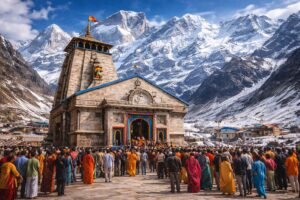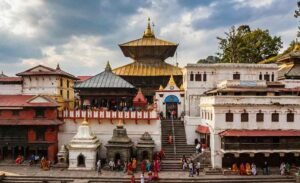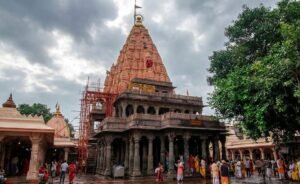
📜 About Bhimashankar Jyotirlinga Temple
Hidden in the Forest, Known to the Heart
If you ask most people to name the twelve Jyotirlingas, Bhimashankar is often the one they pause on. Not because it is less important, but because it is less talked about. Less Instagrammed. Less crowded. And in that quietness lies its extraordinary power.
The Bhimashankar Temple is ancient in a way that hits you differently from other ancient temples. The thick stone walls, the dark interior, the smell of camphor and damp forest air mixing together, the sound of the Bhima River beginning its journey just outside the temple, all of it creates an atmosphere that feels genuinely timeless. You are not visiting a heritage site. You are stepping into a living, breathing, sacred space that has been prayed in, wept in, and rejoiced in for centuries.
The temple is built in the Nagara style of architecture, believed to have been constructed in the 18th century with significant contributions from Nana Fadnavis, the legendary Maratha statesman. But the worship here predates the current structure by centuries. Inscriptions and textual references suggest this has been a sacred site since at least the 13th century, and the mythology behind it reaches back much further, into the age of demons and gods, of sons avenging fathers, and of Shiva appearing in fire to restore justice.
What makes Bhimashankar stand out even among Jyotirlingas is its extraordinary natural setting. The temple sits inside the Bhimashankar Wildlife Sanctuary, a biodiversity hotspot that is home to the endangered Indian Giant Squirrel (Shekru), which is also the state animal of Maharashtra. Walking the forest paths to the temple, you might spot this extraordinary creature leaping through the canopy, a flash of rust and cream against the green. It is one of the few places in India where a pilgrimage and a genuine wildlife encounter are part of the same experience.
The Story — A Son’s Rage, a Demon’s Fall, and Shiva’s Fire
The mythology behind Bhimashankar is one of the most dramatic in the entire Jyotirlinga tradition, a story about a son who did not know his father, a rage that shook the universe, and the moment Lord Shiva himself descended in fire to end it all.
The story begins with Kumbhakarna, the giant demon brother of Ravana who was slain by Lord Rama in the Ramayana. Kumbhakarna had a son named Bhima (not to be confused with the Pandava). Bhima grew up without knowing who his father was. His mother eventually told him, and also told him the truth he found hardest to bear: that his father had been killed by Lord Vishnu’s avatar, Rama.
The young Bhima was consumed by a fury so vast it darkened the sky. He undertook years of ferocious tapasya (penance) dedicated to Lord Brahma, seeking a boon powerful enough to defeat Vishnu and avenge his father. Brahma, bound by the laws of cosmic karma, granted him extraordinary strength and power. Armed with this boon, Bhima declared war on the gods.
He invaded the heavens, defeated Indra, imprisoned the gods, and began terrorising the three worlds. He captured the pious king Kamarupeshwar, who was a devoted Shiva bhakta, and threw him into a dungeon simply for continuing to worship Shiva. Even in captivity, Kamarupeshwar secretly made a clay Shivalinga and worshipped it with unwavering devotion.
Word reached Lord Shiva of his devotee’s plight. And Shiva, who never abandons those who love him, descended into the Sahyadri mountains in a blazing, all-consuming column of fire. The battle between Shiva and Bhima was cosmic in scale. In the end, with a single touch of his third eye, Shiva reduced the demon Bhima to ashes. The gods were freed. The cosmic order was restored.
The assembled gods and sages then prayed to Shiva to remain permanently in the Sahyadri hills so that his divine presence could protect the world forever. Shiva agreed and established himself as the eternal Jyotirlinga of Bhimashankar. The Bhima River, which originates at this spot, takes its name from the demon slain here, not as a tribute to the demon, but as a reminder that even from destruction, life flows.
The Temple — Where Maratha History Meets Ancient Stone
The current Bhimashankar Temple is a compact but deeply impressive structure. The main temple is built in the Hemadpanthi style, a distinctive stone architecture style developed during the rule of the Yadava dynasty in Maharashtra (12th–13th century), characterized by interlocking black stone blocks, no mortar, and intricate geometric carvings. Later, the Peshwas added a beautiful Shikhara (tower) in the Nagara style, and Nana Fadnavis of the Peshwa court constructed the magnificent Sabha Mandap (assembly hall) in the 18th century.
The Jyotirlinga inside the sanctum is notably large, larger than most of the other Jyotirlingas, and is naturally dark in colour. The inner sanctum is small and intimate, and when the oil lamps illuminate the linga during aarti, the flickering golden light against the ancient stone walls creates an atmosphere of extraordinary spiritual intensity. It is the kind of moment that stays with you for years.
Outside the main temple, the complex includes shrines to Goddess Kamalaja (a form of Parvati, considered the guardian of the region), Lord Ganesha, Hanuman, and the Nandi facing the main sanctum. A small stream, the newborn Bhima River, flows past the temple complex, and pilgrims touch its waters as a sacred act before entering.
One of the most visually striking features of Bhimashankar is the view from the temple complex. On a clear day, you can see deep into the Sahyadri valleys below, layers of green hills fading into the distance, with clouds at eye level. On a monsoon day, when the entire landscape is shrouded in mist and the forest is loud with rain and birdsong, the temple feels like it exists at the edge of the world.
The Forest — A Pilgrimage and a Wildlife Sanctuary in One
Bhimashankar is the only Jyotirlinga located inside a designated wildlife sanctuary. The Bhimashankar Wildlife Sanctuary covers 131 sq km of semi-evergreen and moist deciduous forest in the Western Ghats, a UNESCO World Heritage region and one of the world’s 36 biodiversity hotspots.
The sanctuary is the stronghold of the Indian Giant Squirrel (Ratufa indica), locally called Shekru, the state animal of Maharashtra. This remarkable animal, about 45 cm in body length with a tail equally long, colored in rust, cream, and dark brown, is almost exclusively found in the tall forest trees of the Western Ghats. If you walk the forest trail to the temple in the early morning, your chances of spotting a Shekru are genuinely good.
The sanctuary is also home to leopards, Indian giant flying squirrels, Malabar pied hornbills, the Malabar whistling thrush, and an extraordinary variety of butterflies and orchids. In the monsoon season (July–September), the waterfalls around Bhimashankar are in full force, Nagfani, Siddhagad, and several unnamed falls thunder down the Sahyadri slopes, and the entire forest turns an almost unreal shade of green.
Trekkers and birdwatchers come to Bhimashankar from Pune and Mumbai on weekends, and often discover, to their surprise, that the temple and the forest together make for an experience richer than either alone.
The Trek to Bhimashankar
For those who love walking, there are two main trekking routes to Bhimashankar, both starting from Khandas village near Karjat:
- Shidi Ghat Route: The more challenging route, involving a vertical ladder (shidi/shidi in Marathi = ladder) fixed into the cliff face. Steep, adventurous, unforgettable. About 4–5 hours up.
- Ganesh Ghat Route: A longer but less steep trail through beautiful forest. About 5–6 hours up. Passes several ancient temples and forest clearings.
Both routes are well-used but require moderate fitness. The forest can be slippery in monsoon — which is, paradoxically, also the most beautiful time to make the trek. The view from the top of the ghats, looking back down into the Konkan plains below, is one of the most breathtaking in all of Maharashtra.
For those coming by road, Bhimashankar is about 110 km from Pune and 220 km from Mumbai via the Pune-Nashik highway. The last 20 km is a winding mountain road through the sanctuary — drive slowly, watch for wildlife, and enjoy every curve.
Aarti & Daily Rituals
The rituals at Bhimashankar are conducted by the temple trust in accordance with ancient Shaiva traditions. The temple has a calm, unhurried rhythm that matches its forest setting.
- Kakad Aarti (Sunrise Aarti): 4:30 AM — The most sacred aarti of the day; the Shivalinga is bathed in the pre-dawn darkness with milk, honey, and ghee, and the fragrance of camphor and flowers fills the entire forest air
- Panchamrit Abhishek: 6:00 AM — Five sacred substances poured over the linga
- Madhyanha Aarti: 12:00 PM — Midday aarti; temple closed briefly afterward
- Sandhya Aarti: 7:30 PM — Evening aarti as the forest goes quiet
- Shayan Aarti: 9:30 PM — Final aarti of the night
On Mondays and Mahashivaratri, extended abhishek rituals are performed through the night. During Shravan month, the temple sees its highest footfall and special rituals are conducted every day.
Major Festivals
- Maha Shivaratri: The biggest event — thousands of devotees, all-night pujas and bhajans in the forest; a truly unforgettable atmosphere
- Shravan Month: Daily special pujas; massive increase in pilgrims throughout the month
- Tripuri Purnima (Kartik Purnima): Grand fair and special darshan
- Navratri: Nine-day puja dedicated to Goddess Kamalaja
- Diwali: Temple illuminated with thousands of diyas; spectacular in the forest setting
How to Reach Bhimashankar
By Air: Nearest airport is Pune International Airport (110 km). From Pune, hire a cab or take a bus to Bhimashankar.
By Train: Nearest station is Karjat (Mumbai–Pune railway line, 50 km from Bhimashankar) or Pune Junction (110 km). From Karjat, shared jeeps and taxis are available.
By Road: From Pune (110 km) via Manchar or Rajgurunagar. From Mumbai (220 km) via Pune-Nashik highway and Ghodegaon. Last stretch is a forest mountain road — no buses after Ghodegaon; shared jeeps or own vehicle recommended.
By Trek: Two routes from Khandas village near Karjat — Shidi Ghat (4–5 hrs, steep) and Ganesh Ghat (5–6 hrs, scenic).
Nearby Attractions
- Bhimashankar Wildlife Sanctuary — Forest trails, birding, Indian Giant Squirrel sightings
- Nagfani Point — Spectacular viewpoint overlooking the Konkan plains; best in monsoon
- Hanuman Lake — Sacred lake near the temple
- Siddhagad Fort — Historic Maratha fort in the sanctuary
- Shidi Ghat Viewpoint — Dramatic cliff-edge views of the Western Ghats
- Pune (110 km) — Shaniwarwada, Dagdusheth Ganpati, Osho Ashram
- Trimbakeshwar (125 km) — Seventh Jyotirlinga, near Nashik
Why Bhimashankar Is the Jyotirlinga for the Soul That Needs Silence
There is a type of devotee who doesn’t need a crowd to feel God’s presence. Who finds the divine more clearly in the sound of a river than in the clang of temple bells. Who breathes easier when the air smells of forest rather than incense smoke. For that devotee — and perhaps for all of us, at some point in our lives — Bhimashankar is the Jyotirlinga.
The forest holds the temple like cupped hands hold water. The Bhima River begins its thousands-of-kilometres journey to the sea in a whisper right outside the sanctum walls. The Giant Squirrel leaps through the canopy above you. The mist rolls in from the Sahyadri valleys. And in the middle of all this natural abundance and ancient sacred power, the Jyotirlinga of Bhimashankar pulses with a quiet, steady energy that asks nothing from you except your presence.
Show up. Be still. That is enough.
🗿 Temple Murti / Statue
भीमाशंकर ज्योतिर्लिंग — सह्याद्री वन, पुणे, महाराष्ट्र
Darshan & Aarti Timings
🚪 Darshan Timings
🪔 Aarti Schedule
⭐ Best Time to Visit
⚠️ Timings may change on festivals, special occasions, or during temple renovation. Please verify with the temple before visiting.
Visitor Information
🗺️ Location & How to Reach
Pune International Airport (110 km)
Karjat (50 km) | Pune Junction (110 km)
Ghodegaon Bus Stand (20 km from temple)