📜 About Baidyanath Dham, Deoghar
The Temple Ravana Built — And Could Not Take Away
Let us start with Ravana. Not the villain of the Ramayana, though he is that too, but the Ravana who is rarely talked about: the greatest devotee of Lord Shiva who ever lived.
Ravana was not merely evil. He was extraordinary. He was a scholar of the Vedas, a master of the Sama Veda, a composer of the Shiva Tandava Stotram, one of the most beautiful and powerful hymns to Lord Shiva ever written. He was also, by the reckoning of Hindu tradition, possibly the greatest Shiva bhakta of his age. And it was his devotion, mixed with his ambition, his ego, and his desperate longing for the one thing he could not conquer by force, that brought him to the small hillock in what is now Deoghar, Jharkhand.
The story goes like this:
Ravana wanted to take the Jyotirlinga of Shiva from Mount Kailash back to Lanka. He believed that if he could establish this linga in Lanka, his kingdom would become invincible and eternal. He performed extraordinary tapasya on Kailash, cutting off his ten heads one by one and offering them to the sacred fire as oblations. Each time, Shiva restored the head before the next was cut. Finally, as Ravana was about to cut the last head, Shiva appeared, deeply moved by this extreme act of devotion.
Shiva granted Ravana a Jyotirlinga, but with a condition: “You may carry this linga to Lanka, but you must never set it down on the earth before you reach there. If you do, it will establish itself permanently at that spot and you will not be able to move it.”
Ravana agreed and began carrying the linga southward toward Lanka. But the gods were alarmed, an invincible Lanka with a Jyotirlinga was too dangerous for the cosmic order. They devised a plan. Lord Vishnu caused the sun to set early, making it appear to be evening. The demon king Ravana suddenly felt an overwhelming urge to perform his evening prayers, and prayers require setting the linga down momentarily. Vishnu sent the god Varuna to enter Ravana’s body and make his bladder unbearably full. Ravana, desperately needing to answer the call of nature, looked around for someone to hold the linga.
A boy appeared, Lord Vishnu in disguise. Ravana handed the linga to the boy with strict instructions: “Do not put this down under any circumstances.” The boy agreed, and then, after a few minutes, claimed his arms were too tired and placed the linga gently on the earth.
It sank in immediately. Became one with the earth. Permanent. Immovable.
Ravana rushed back, furious. He tried to pull the linga out with his bare hands, his twenty immensely powerful arms. The ground did not yield. He pressed so hard that the top of the linga bent slightly under the pressure of his thumbs, and that slight indentation, that mark of Ravana’s desperate grip, can still be seen on the Jyotirlinga of Vaidyanath today.
Ravana failed to take the linga. But before he left, he worshipped it with flowers, incense, and water. Lord Shiva, touched by this act of devotion from a devotee who had just failed spectacularly, blessed Ravana and gave him healing powers, making him the divine physician, Vaidya. And so this linga, where the greatest devotee of Shiva worshipped and was healed, came to be known as Vaidyanath, the Lord who heals.
Deoghar — The City of Gods
The name Deoghar means exactly what it sounds like: Deo (God) + Ghar (Home), the Home of God. And in a country filled with sacred cities, Deoghar carries this name with quiet confidence. It is not as loud as Varanasi, not as dramatic as Kedarnath, not as historically battered as Somnath. Deoghar is a gentler kind of sacred, a small, orderly town in the plains of Jharkhand, surrounded by small hills, where the sacred and the everyday coexist without drama.
But do not mistake the quiet for ordinariness. During Shravan month, the holy month dedicated to Lord Shiva, Deoghar becomes, without exaggeration, one of the most intensely alive places on earth. The Shravani Mela held at Baidyanath Dham during this month is one of the largest religious gatherings in the world, drawing anywhere between 50 lakh to 1 crore pilgrims over the month. The entire length of road from Sultanganj on the Ganga, a distance of 105 kilometres, is covered on foot by barefoot pilgrims, carrying pots of sacred Ganga water on decorated bamboo poles (called Kanwad), chanting “Bol Bam, Bol Bam” with every step.
This is the Kanwar Yatra, and at Deoghar, it reaches its greatest intensity. These pilgrims, called Kanwariyas, walk for days, sometimes over 100 km, sleeping on roadsides, through rain and heat, to bring the sacred water of the Ganga to pour on Baba Baidyanath’s linga. The orange of their clothing, the chanting of Bol Bam, the decorated kanwads bouncing on the shoulders of millions of walking pilgrims, it is one of the most visually arresting and emotionally overwhelming sights in all of Indian religious life.
The Temple Complex — Twenty-Two Temples in One
What most pilgrims don’t realize until they arrive is that Baidyanath Dham is not one temple, it is twenty-two.
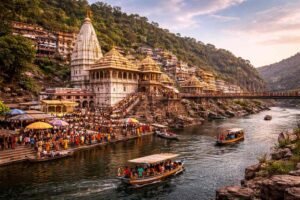
The main Vaidyanath Temple sits at the center of a large walled compound, surrounded by 21 other temples, each dedicated to a different form of Shiva, Parvati, Ganesh, Vishnu, and other deities. The entire compound, called the Baidyanath Temple Complex, is one of the most densely sacred spaces in India, a place where the divine seems to be present not just in one spot but everywhere, in every corner, in every stone.
The main temple is built in the Nagara style, with a shikhara that rises about 72 feet above the sanctum. The shikhara has a distinctive feature: a five-pointed golden crown (Panchashool) at the very top — a symbol of Shiva’s five cosmic functions (creation, preservation, dissolution, concealment, and liberation). This golden crown is so sacred that it is touched only by the head priest, and its annual cleaning ceremony is itself a major religious event attended by thousands.
The Vaidyanath Jyotirlinga inside the main sanctum is a smooth, rounded linga about 60 cm tall. If you look closely, and you will have to, because the sanctum is always crowded with devotees, you can make out the slight indentation on the top of the linga. That is Ravana’s thumbprint. Five thousand years of abhishek and prayer have worn it smooth, but the mark is still there. The mark of the greatest devotee who ever loved a god and lost a bet.
Adjacent to the main temple is the Parvati Temple, where the Goddess is worshipped as Jayadurga. This is the Shakti Peetha aspect of Deoghar, where the heart of Goddess Sati is believed to have fallen when Vishnu’s Sudarshana Chakra severed her body. The combination of the Jyotirlinga and the Shakti Peetha in the same complex makes Baidyanath Dham one of the rarest and most powerful pilgrimage sites in Hinduism, equaling Srisailam in this unique dual sanctity.
The Sulfur Spring — Ancient Science at the Temple
Here is something that most guidebooks miss: in the lane behind the Vaidyanath Temple, there is an ancient natural sulfur spring, called Shivaganga or Shivakund, whose waters have been used for ritual bathing and healing for centuries. Pilgrims bathe here before entering the temple, and the water is said to have curative properties for skin diseases and joint ailments.
This is not coincidence. The name Vaidyanath, the divine physician, is reflected in the very geology of the place. Ancient pilgrims who came here sick and bathed in the sulfur spring before offering prayers at the linga did, in fact, often feel better. Whether it was the sulfur in the water, the power of the prayer, or both, the reputation of Baba Baidyanath as the healer of all ills has been earned over millennia of actual experience.
The Sultanganj Connection — 105 km of Faith
No account of Baidyanath Dham is complete without talking about Sultanganj.
Sultanganj is a town on the banks of the Ganga in Bihar, about 105 kilometres from Deoghar. Every year during Shravan, pilgrims begin their Kanwar Yatra from here, filling their copper pots with sacred Ganga water at the Sultanganj Ghat and then walking the entire 105 km to Deoghar without letting their kanwad touch the ground, without their feet touching a vehicle, sometimes without sleeping more than a few hours each night.
This 105-kilometre stretch of road during Shravan is something you have to see to believe. The entire road is covered with a moving river of orange, millions of pilgrims walking in both directions, decorated kanwads everywhere, small makeshift temples and Shiva shrines every few hundred metres, volunteer camps serving free food and water, the constant chanting of Bol Bam like a tide that never recedes. It is one of the largest peaceful human gatherings on earth, and almost entirely unknown outside India.
If you are visiting Baidyanath Dham, try to do the Sultanganj walk, even a portion of it. You will understand something about faith, community, and human endurance that no book can explain.
Aarti & Daily Rituals
The daily rituals at Vaidyanath Temple follow a schedule that has barely changed in centuries:
- Pratah Puja (Morning Opening): 4:00 AM, The temple opens before dawn. The Shivalinga is bathed in the pre-dawn darkness. The first water poured on the linga every morning is from the Shivaganga spring, continuing a tradition that stretches back further than recorded history.
- Abhishek Darshan: 4:00 AM – 3:30 PM — General darshan with abhishek allowed; pilgrims may pour water on the linga themselves during this time
- Madhyanha Aarti: 12:00 PM — Midday aarti and bhog offering
- Sandhya Aarti: 6:00 PM — Evening aarti; one of the most atmospheric moments of the day as the temple lights up
- Shayan Aarti: 9:00 PM — Final night aarti before the deity rests
The Shringar Darshan — when the deity is dressed in royal clothes and ornaments — happens twice daily and is considered especially auspicious. During Shravan month, the temple operates almost around the clock to accommodate the massive influx of Kanwariyas.
Major Festivals
- Shravani Mela (Entire Shravan Month — July/August): The defining event of Deoghar — 50 lakh to 1 crore pilgrims over the month. Every day is a festival. The town transforms completely. This is without question one of the largest religious gatherings in the world.
- Maha Shivaratri: All-night puja with massive crowds; the second most important event after Shravani Mela
- Basant Panchami: Spring festival with special rituals; large fair in the temple grounds
- Navratri: Nine-day festival with special pujas at the Jayadurga (Parvati) temple — the Shakti Peetha aspect is especially celebrated
- Kartik Purnima: Sacred fair and special darshan
- Bol Bam / Kanwar Yatra Season: All of Shravan is essentially one continuous festival
How to Reach Deoghar
By Air: Deoghar now has its own airport — Deoghar Airport (8 km from the temple) — inaugurated in 2022, with flights from Delhi, Kolkata, and Mumbai. This has made Baidyanath Dham significantly more accessible for pilgrims from across India.
By Train: Baidyanath Dham Railway Station (also called Deoghar Station) is 1.5 km from the temple — extremely convenient. Connected to Jasidih Junction (7 km), which is on the main Howrah-Delhi railway line and has better connectivity. From Jasidih, auto-rickshaws and taxis to Deoghar.
By Road: Deoghar is 340 km from Patna, 280 km from Ranchi, 220 km from Dhanbad, 260 km from Kolkata (via Asansol). NH-114A connects Deoghar to major cities. Regular buses from Ranchi, Dhanbad, Bokaro, and Jamshedpur.
Essential Tips for Baidyanath Dham Visit
- 🗓️ Avoid Shravan month if you want a calm, quiet experience — the crowds are overwhelming for first-time visitors
- 🌿 Visit during Shravan if you want to witness one of the greatest displays of collective faith on earth — just be prepared for massive crowds and bring patience
- 🪣 Kanwar Yatra: If you attempt even a short stretch of the Sultanganj walk, start at 4 AM and carry sufficient water
- ⏰ Best darshan time: Weekday mornings between 4–7 AM, before the crowds build
- 🔒 Valuables: Leave in hotel locker — the market area around the temple is very crowded
- 🏥 Medical facilities: Good hospitals in Deoghar town; altitude is low, so no altitude concerns unlike northern temples
Nearby Attractions
- Shivaganga (Sulfur Spring) — Sacred healing spring behind the main temple
- Nandan Pahar — Recreational hills with temple and viewpoint, 2 km from main temple
- Trikut Pahar (10 km) — Three-peaked hill with ropeway and ancient temples
- Basukinath Temple (42 km) — Extremely important Shiva temple; pilgrims visit both Baidyanath and Basukinath as a combined yatra
- Sultanganj (105 km) — Start of the Kanwar Yatra; sacred Ganga ghat; ancient Ajgaivinath Temple on a rock island in the Ganga
- Jasidih (7 km) — Railway junction with better train connectivity
- Dumka (67 km) — Headquarters of Santhal Parganas; scenic tribal region
Why Baba Baidyanath Is Called The Healer of All Ills
Every Jyotirlinga heals in some way — every sacred space does, if you come to it with an open heart. But Vaidyanath has made healing its entire identity. The very name says it: Vaidya — the doctor. The healer. The one who knows the medicine for every ailment.
And people come here with every kind of ailment. Not just the physical ones — though many do come seeking cure for chronic illness, praying for the recovery of loved ones, seeking the blessing of the divine physician for health and long life. They come with broken marriages and broken careers and broken hearts. They come carrying grief so old it has become part of their bones. They come when the doctors have said there is nothing more to do, when the world has run out of answers, when the only place left to turn is somewhere beyond the rational.
And Baba Baidyanath receives them all. The kanwariya who has walked 105 km on blistered feet, and the wealthy pilgrim who flew in from Mumbai. The young woman who comes every year for her ailing mother, and the old man who has come for the last time, knowing it is the last time. They all stand before the same linga, pour their water, whisper their prayer, and receive the same silence — a silence that somehow feels like an answer.
That is what the divine physician gives. Not always a cure. But always a response. Always a presence. Always the sense that you have been heard.
Come to Deoghar. Come to Baba.
Whatever ails you — bring it here.
🗿 Temple Murti / Statue
वैद्यनाथ ज्योतिर्लिंग — रावण के अँगूठे का निशान, देवघर, झारखंड
Darshan & Aarti Timings
🚪 Darshan Timings
🪔 Aarti Schedule
⭐ Best Time to Visit
⚠️ Timings may change on festivals, special occasions, or during temple renovation. Please verify with the temple before visiting.
Visitor Information
🗺️ Location & How to Reach
Deoghar Airport (8 km) — Delhi, Kolkata, Mumbai flights
Baidyanath Dham Station (1.5 km) | Jasidih Junction (7 km — better connectivity)
Deoghar Bus Stand (1 km)