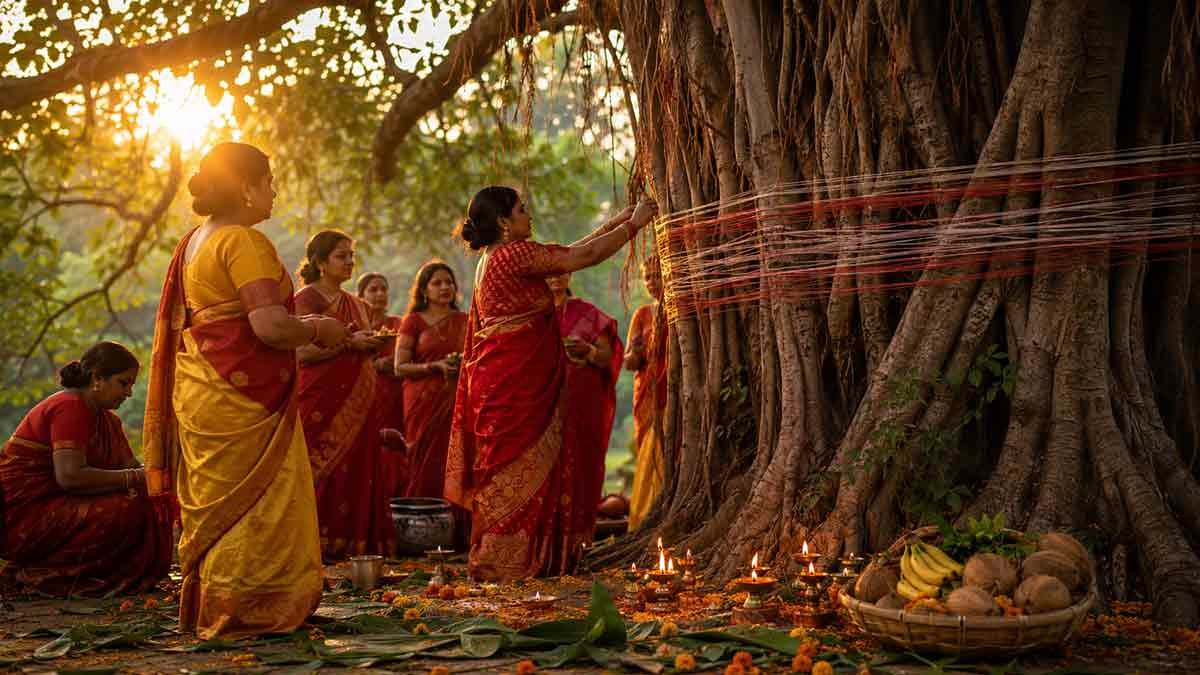
There is something about the morning of Bat Savitri that feels different from every other day of the year. In small towns and big cities across Bihar, you’ll see groups of women in red and yellow sarees, plates balanced on their hips, walking together towards the nearest banyan tree before the sun gets harsh. Some are talking. Some are silent. Most haven’t had even a sip of water since the night before.
If you grew up in Patna, Gaya, Muzaffarpur, or anywhere in the Bhojpuri or Mithila belt, you already know the scene. Your mother probably did it. Your grandmother almost certainly did. And whether or not you’ve ever observed the vrat yourself, the story of Savitri – the woman who argued with Yamraj and won – is one you’ve heard a hundred times.
This year, Bat Savitri Vrat 2026 falls on Saturday, 16 May, on Jyeshtha Amavasya. Here’s everything you need to know about the day – the story, the rituals, the samagri, and why the banyan tree, of all trees, stands at the centre of it all.
What is Bat Savitri Vrat?
“Bat Savitri” is what most of Bihar, eastern UP, and Jharkhand call this festival. In Sanskrit and most other parts of North India, it’s “Vat Savitri” – “vat” being the word for banyan. The pronunciation shifts in our part of the country, but the meaning doesn’t change.
It is a fast observed by married Hindu women for the long life, health, and well-being of their husbands. The day takes its name from two things: the banyan tree (bat vriksha) that is worshipped, and Savitri, the legendary princess of the Mahabharata who refused to let her husband die.
In North India – Bihar, UP, MP, Rajasthan, Haryana – the vrat is kept on Jyeshtha Amavasya (the new moon of Jyeshtha). In Maharashtra, Gujarat, Goa, and parts of South India, the same festival is observed fifteen days later on Jyeshtha Purnima and called Vat Purnima. Same goddess, same tree, same prayer – just a different lunar day.
Bat Savitri Vrat 2026: Date and Shubh Muhurat
For everyone observing the vrat in Bihar and the rest of North India:
- Date: Saturday, 16 May 2026
- Jyeshtha Amavasya begins: 05:11 AM on 16 May 2026
- Jyeshtha Amavasya ends: 01:30 AM on 17 May 2026
- Brahma Muhurat: Around 4:12 AM – 5:00 AM
- Morning Puja Muhurat: 6:00 AM – 7:30 AM
- Abhijit Muhurat: Approximately 11:48 AM – 12:36 PM
This year is considered especially auspicious because the vrat coincides with Shani Jayanti – a rare overlap that older Pandits in Bihar are calling a “Shanichari Amavasya” yog. Many families plan extra Shani dev offerings alongside the regular Bat puja.
Note: Timings are approximate. Check your local Panchang or your family purohit for the exact muhurat in your city.
The Story of Savitri and Satyavan – Told the Way Your Dadi Used to Tell It
Every vrat has a katha, and this one is among the most beautiful in Hindu tradition. The full story is in the Vana Parva of the Mahabharata, narrated by Sage Markandeya to Yudhishthira.
Long ago, there lived a king named Ashwapati who had no children. After years of austerity and prayer to Goddess Savitri, a daughter was born to him – and he named her Savitri, after the goddess herself.
Savitri grew up extraordinary. So intelligent, so radiant, so spiritually strong that no man dared ask for her hand. Eventually, her father told her to go and find her own husband. She travelled through forests and ashrams and came back with her choice: Satyavan, the son of a blind, exiled king living in the forest.
Then came the warning from Sage Narada. Satyavan, he said, was destined to die exactly one year from that day.
Her parents begged her to choose again. Savitri refused. “I have chosen him once,” she said. “I cannot choose another.”
She married Satyavan, gave up her royal clothes, moved to the forest hut, and served her in-laws. And she counted the days.
On the morning of the predicted day, she fasted, prayed, and insisted on going with Satyavan when he left to gather firewood. In the forest, he suddenly felt weak, lay down with his head in her lap – and died.
That’s when Yamraj appeared. The god of death himself, come personally because Satyavan was no ordinary soul. He bound Satyavan’s spirit and began to leave.
Savitri got up and followed him.
Yamraj turned around. “Go back, child. The living cannot follow the dead.”
She didn’t argue with him. She spoke to him – about dharma, about righteousness, about the duties of a wife, about the nature of the soul. So wise were her words that Yamraj was moved. He offered her a boon – anything except Satyavan’s life.
She asked for her father-in-law’s sight to be restored. Granted.
She kept walking behind him. He offered another boon. She asked for her exiled father-in-law’s kingdom back. Granted.
Still she walked. A third boon. She asked for a hundred sons for her own father, who had no male heir. Granted.
A fourth boon. And this is the moment every Bihari grandmother delivers with a small smile: Savitri asked for a hundred sons of her own.
Yamraj agreed – and then realised what he had done. For her to have sons, Satyavan had to live.
Bound by his own word, Yamraj released Satyavan’s soul. Savitri walked back to the banyan tree where her husband’s body lay, and he opened his eyes as if waking from sleep.
That is why, on this day, married women worship the banyan tree – because it is said Satyavan’s body lay beneath one while Savitri argued with death itself.
Why the Banyan Tree?
The bat vriksha is not chosen at random. In Hindu tradition, the banyan is the tree of Trimurti – its roots represent Brahma, its trunk Vishnu, and its branches Shiva. Its aerial roots, which drop down and form new trunks, make it a tree that essentially never dies. It is the perfect symbol for the prayer being made: let my husband live long, like this tree.
Botanically too, the banyan releases oxygen for an unusually long time and provides deep shade. Sitting under it for a morning puja in May, when Bihar’s heat is already brutal, is no accident – the tree itself is part of the blessing.
Bat Savitri Puja Samagri List
Before the morning of the vrat, most women in Bihar prepare a bans ki tokri (a small bamboo basket) and fill it with the puja items. Here is the standard samagri list:
- Bamboo basket (bans ki dauri / tokri)
- Bamboo hand fan (pankha) – this is especially important in Bihar
- Red or yellow new cloth
- Kachcha sutra (raw white thread / cotton)
- Mauli (red sacred thread)
- Sindoor, haldi, roli, kumkum, chandan
- Akshat (unbroken rice)
- Flowers – preferably red or yellow
- Mango leaves (aam ke patte)
- Coconut (nariyal)
- Fruits – banana, mango, jamun, litchi (whatever is in season)
- Bhigoye hue kala chana (soaked black gram) – this is essential
- Sattu, gud, and bargad-shaped sweets in some families
- Paan, supari, mooli (radish)
- Belpatra
- Ghee diya, dhoop, agarbatti
- Gangajal or fresh water in a small kalash
- Solah shringar samagri – bangles, bindi, chunri, mehndi
- A picture or small idol of Savitri and Satyavan (optional but common)
- Coins for daan
In Bihar specifically, the pankha (hand fan) and the kala chana are non-negotiable. The fan is later used to fan the husband – a quiet, beautiful ritual that we’ll come to. The chana is said to represent the twelve gram seeds Yamraj returned to Savitri as Satyavan’s life force.
Bat Savitri Puja Vidhi – Step by Step
This is the traditional vidhi as followed across most Bihari households. Adapt it to your family’s parampara – there are small variations from district to district.
1. Before Sunrise
Wake up early, ideally during Brahma Muhurat. Take a bath, wear clean red or yellow clothes. Put on full shringar – sindoor, bindi, bangles, mehndi. Apply tilak.
2. Take the Sankalp
Sit facing east, close your eyes, fold your hands, and take the sankalp – the formal vow. State your name, your gotra (if known), and the purpose: “I am observing this Bat Savitri Vrat for the long life, health, and prosperity of my husband, with Savitri Mata as my witness.”
Many women begin a nirjala vrat here – no food, no water until the puja is complete. Others keep a phalahari vrat (fruits and milk allowed). Both are valid. Pick what your health allows.
3. Reach the Banyan Tree
By 7 or 8 in the morning, women gather near the nearest banyan tree. In Patna, the bigger trees around Mahavir Mandir, Hanuman Mandir Kankarbagh, and along the Ganga ghats see hundreds of women on this day.
Sweep the area around the roots. Sprinkle Gangajal. Apply haldi, roli, and sindoor to the trunk of the tree – yes, you are dressing the tree like a bride.
4. The Parikrama
This is the heart of the ritual.
Light a ghee diya at the base. Offer water, flowers, fruits, sweets, and the soaked chana. Then, holding the kachcha sutra (raw thread), begin walking around the tree.
You walk seven times (some families say 11, some 108 – seven is most common in Bihar). With each parikrama, you wind the thread around the trunk. With every round, you chant in your mind or aloud:
“Vat vriksha ki chhaya mein jaise Savitri ne suhag paya, waise hi mera bhi suhag akhand rahe.”
(“As Savitri received her husband under the shade of this banyan, may my marriage too remain eternal.”)
5. Read or Listen to the Katha
After the parikrama, sit down with the other women and read or listen to the Vat Savitri Vrat Katha – the full Savitri-Satyavan story. In most family circles, one elder reads it aloud while the rest listen, their hands folded.
6. Aarti and Bhog
Perform the aarti of Savitri Mata. Offer the bhog – usually puri, kala chana, gud, and seasonal fruits – and then distribute it as prasad to everyone present.
7. The Pankha Ritual (Bihar Special)
This is one of the most touching parts of the day, and it is specific to Bihar and Jharkhand. After returning home, women fan their husbands with the bamboo hand fan from the puja basket – a symbolic gesture of giving him comfort, cool air, and peace.
In many homes, the husband touches the wife’s feet first, then she fans him. It is a moment of quiet tenderness that doesn’t get talked about much, but anyone who has seen it in their own home remembers it.
8. Daan
Before opening her own fast, a married woman donates the bans ki tokri – with chana, fruits, coconut, shringar items, and a hand fan – to a Brahmin lady, her saas, jethani, or married sister. This sharing of saubhagya is considered as important as the puja itself.
9. Break the Fast
Break the vrat in the afternoon or evening, depending on family tradition. Most begin with water and then satvik food – no onion, no garlic, no non-veg. Many families eat the same kala chana and gud that was offered to the tree.
Things to Keep in Mind on the Day
A few quiet rules that elders in Bihar will remind you about:
- Don’t speak harshly to anyone, especially your husband or in-laws, on this day.
- Don’t cut anything sharp – no nails, no thread, no scissors during puja hours.
- Don’t break a tulsi leaf or pluck flowers from the banyan tree itself; only use what has already fallen or what you’ve brought.
- If you can’t reach an actual banyan tree (common in apartment-heavy cities), a small banyan branch placed at home and worshipped is acceptable. The intention matters more than the geography.
- Pregnant women, women with health conditions, or those who simply cannot fast should observe the phalahari form. The vrat is not meant to harm you.
Can Unmarried Girls Keep the Bat Savitri Vrat?
This question comes up often. Traditionally, the vrat is for married women – but in many families, unmarried girls also keep it, praying for a good life partner and a stable future marriage. There is no shastric rule that forbids it. If you wish to keep it for that intention, you can – quietly, with full faith.
What Makes Bat Savitri 2026 Special
Three things make this year’s vrat unusual:
- It falls on a Saturday – coinciding with Shani Jayanti. The overlap is being read as a powerful yog for both marital well-being and freedom from Shani dosha.
- The Amavasya tithi starts very early in the morning (5:11 AM), which means the udaya tithi rule is cleanly satisfied – there is no confusion about whether to observe it on 16 or 17 May.
- For Mithila and Bhojpuri regions, this year’s vrat falls in a week relatively free of major clashing observances, which means full households can participate without divided attention.
Frequently Asked Questions
Is Bat Savitri the same as Vat Savitri?
Yes. “Bat” is the Bihari and Bhojpuri pronunciation of “Vat” (banyan). The vrat, the story, and the rituals are identical.
When is Bat Savitri Vrat 2026?
Saturday, 16 May 2026, on Jyeshtha Amavasya, in Bihar and across North India.
Can I keep the vrat without water (nirjala)?
You can, but only if your health permits. If you cannot, a phalahari (fruits and water) fast is fully accepted.
Do I have to find an actual banyan tree?
Ideally yes, but if you cannot reach one, a banyan branch placed at home and worshipped with the same vidhi is acceptable.
What is the most important mantra for the day?
“Avaidhavyam cha saubhagyam dehi tvam mama suvrate.
Putran pautranshcha saukhyam cha grihanaarghyam namostute.”(Grant me unwavering saubhagya, sons, grandsons, and joy. I bow to you and offer this arghya.)
What should I cook to break the fast?
Sattvic food – puri, sabzi (no onion-garlic), kala chana, kheer, and seasonal fruits. Many families eat the prasad itself.
My mother-in-law and I belong to different regions. She observes Vat Purnima, I observe Bat Savitri. Which should I follow?
Both are valid. Most families let the daughter-in-law continue her maternal tradition, but if you wish to align with your sasural, simply ask. There is no shastric conflict.
A Closing Thought
Bat Savitri is not really a fast about food and water. It is a fast about memory.
Every generation of women, walking around that banyan tree at sunrise, is reminding herself of one of the strongest characters in Hindu mythology – a woman who argued with the god of death and brought her husband home. The thread you wind around the trunk is the same thread your grandmother wound. The chana you soak the night before is the same chana your great-grandmother soaked. The pankha you fan your husband with is older than your marriage.
That is what this day is. A long, unbroken thread between the women of one home, across centuries.
This year on 16 May 2026, if you are observing the vrat – may your puja be complete, your husband healthy, and your saubhagya akhand.
🙏 Jai Savitri Mata.