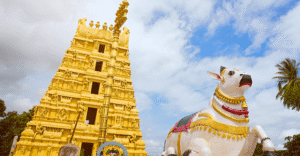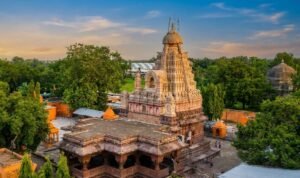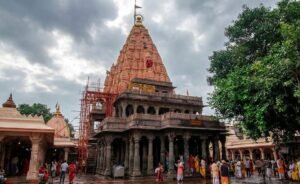
📜 About Ramanathaswamy Jyotirlinga Temple (Rameshwaram)
Where Vishnu Bowed Before Shiva — and the Ocean Watched
The Ramayana is one of the longest, most complex, most emotionally layered stories ever told. It has war and exile, love and betrayal, devotion and temptation, courage and grief. But if you had to find the single most theologically significant moment in the entire epic, not the most dramatic, not the most action-packed, but the most important in terms of what it reveals about how the universe works, it might be this one:
The battle is over. Ravana is dead. Sita is rescued. Lanka is burning. And Rama, who has just won the most decisive military victory in the history of the cosmos, does not celebrate. Does not declare himself king. Does not even go home.
He comes to this island. He kneels in the sand. And he builds a Shivalinga.
Why? Because Rama had killed, not just soldiers, but the entire Rakshasa lineage of Lanka. Thousands of beings. And however justified the killing was, however necessary, however divinely ordained, Rama understood that taking life carries weight. The dharmic warrior is not absolved by victory alone. That something must be offered, atoned for, returned to the sacred order. And so he came to the southernmost point of India, faced the vast Indian Ocean, and built a linga of sand with his own hands, dedicating it to Lord Shiva, asking for cleansing, asking for peace, asking for the weight of all that death to be lifted from his soul.
Shiva appeared. Blessed Rama. And told him: “Since you have established this linga here, this place shall be called Rameshwaram, the Lord of Rama, and the linga shall be known as Ramanathaswamy, the Lord who is Rama’s God.”
That is Rameshwaram. That is what this island holds. Not just a Jyotirlinga, but the memory of the greatest devotion in the greatest story ever told.
The Island, Where India Ends and Wonder Begins
Rameswaram Island is unlike any other place in India. It is not a dramatic island, not volcanic, not mountainous, not ringed by cliffs. It is flat, low-lying, surrounded by shallow turquoise sea on all sides, with white sand and casuarina trees and fishing boats and the smell of salt and flowers. The light here is different from the rest of India, flatter, sharper, somehow both softer and more intense, bouncing off the water and the white sand and the white walls of the temple until everything glows.
The island is connected to the mainland at Mandapam by the Pamban Bridge, a 2.3-kilometre rail bridge built in 1914, with a retractable central span that opens to allow ships through. For decades, this was the longest sea bridge in India. The train journey across Pamban is one of the most extraordinary in India, sitting in a railway carriage as it inches across the ocean, with sea on both sides, the water sometimes just a few feet below the tracks, and the white dome of the temple visible in the distance. There is no other train journey quite like it anywhere in the country.
The island itself is associated with the Ramayana at every point. The coral reef to the southeast is called Adam’s Bridge, or Ram Setu in Hindu tradition, the chain of limestone shoals believed to be the remains of the bridge that Rama’s army of vanaras (monkey warriors) built across the strait to Lanka. On a clear day and from a height, you can trace the broken line of this ancient natural formation stretching toward Sri Lanka, 22 kilometres away. Whether you believe it is a divine construction or a geological formation, there is something indisputably extraordinary about standing on this island and seeing that line of rocks reaching toward the horizon.
The Temple — The Longest Corridor in the World
Let us be direct about something: the Ramanathaswamy Temple is, architecturally speaking, one of the most extraordinary buildings in India. Not because of its height or its gold or its antiquity, but because of its corridors.
The temple has four prakarams (enclosing corridors), and the third prakaram corridor. the outer passage that runs around the entire inner complex, is 1,220 metres long. That is more than a kilometre of unbroken corridor, lined on both sides by thousands of intricately carved stone pillars, each slightly different from the last, the columns receding into the distance until they disappear into shadow. Walking this corridor, which takes 15-20 minutes at a comfortable pace, is one of the most genuinely awe-inspiring physical experiences in any temple in India. Not the largest. Not the tallest. But the sheer, overwhelming continuity of it, pillar after pillar after pillar, stretching into the dark, the light coming from oil lamps suspended between the columns, does something to your perception of time and space that is difficult to describe and impossible to forget.
The temple was built and expanded over many centuries, with major contributions from the Pandya dynasty, the Setupati kings of Ramanathapuram, and various later rulers. The massive Gopurams (gateway towers), the tallest rising to 53 metres, were built in the Dravidian style and are covered in thousands of painted stucco figures. There are 22 sacred wells within the temple complex, each with a different name, and bathing in all 22 wells (called Theerthams) is considered one of the most purifying rituals in Hindu pilgrimage, equivalent to bathing in all the sacred rivers of India in a single morning.
The Two Lingas — Ramalingam and Vishwalingam
Here is a detail that most people who visit Rameshwaram don’t know, a detail that makes the theology of this temple extraordinarily layered and beautiful.
There are two Jyotirlingas in the main sanctum, not one. Side by side. Each with its own story.
The first, called Ramalingam, is the linga that Rama built himself out of sand from the beach, shaped by his own hands, on the morning of the battle preparations. This is the self-made linga of the king-god, the devotee’s devotee, the warrior who bowed.
The second, called Vishwalingam, was brought by Hanuman from Kailash. Rama had asked Hanuman to fly to Kailash and bring a proper stone linga for the ceremony, since a sand linga seemed inadequate for so great an occasion. But Hanuman, the greatest devotee who ever lived, the one being whose love for Rama was so complete that it bent the laws of the universe, took longer than expected. The auspicious time for the installation was approaching. Sita made a linga from the available sand with her own hands, and Rama installed it.
When Hanuman returned with the Kailash linga, he was devastated, he had been too late. Rama, seeing Hanuman’s distress, came up with a solution of extraordinary grace: he decreed that the Vishwalingam brought by Hanuman would be placed beside the Ramalingam, that the Vishwalingam would be worshipped first in every ritual, and that any pilgrimage to Rameshwaram that did not include the darshan of the Vishwalingam would be considered incomplete. In one act, Rama ensured that Hanuman’s devotion was honoured for eternity, that no pilgrim who came here would fail to acknowledge what Hanuman brought, and that the love of the devotee would forever stand beside the linga of the Lord.
That is Rameshwaram. That is the kind of temple this is.
The 22 Theerthams — Bathing in Every Sacred River at Once
Within the Ramanathaswamy Temple complex, there are 22 sacred wells, called Theerthams, each dug at a different point in the Ramayana story, each believed to contain water with different sacred properties and benefits. Bathing in all 22 theerthams, in the specified order, is one of the most important rituals of the Rameshwaram pilgrimage.
The experience is as follows: temple attendants lead you from well to well through the corridors. At each well, they draw the water up in a large bucket and pour it over you, completely, bucket by bucket. By the time you have bathed in all 22, you are thoroughly soaked, smelling of sacred water, and standing in a slightly dazed state of devotional completion that most pilgrims describe as unlike anything else they have experienced in a temple.
Each well has a name connected to a specific event or being from the Ramayana. The Agni Teertha (the sea itself, just outside the temple) is considered the most sacred — the final bath, taken in the ocean after completing the 22 indoor theerthams. Bathing in Agni Teertha at sunrise, with the sun coming up over the Bay of Bengal and the temple towers behind you, is one of the great moments of the South Indian pilgrimage tradition.
Adam’s Bridge — Ram Setu — The Bridge That Divides Science and Faith
Visible from the eastern shore of Rameswaram Island, stretching toward Sri Lanka across the Palk Strait, is a chain of limestone shoals, sandbanks, and small islands that has been the subject of one of the most persistent debates in Indian public life: Ram Setu.
In Hindu tradition, this is the remains of the bridge built by Rama’s vanar army, millions of stones inscribed with Rama’s name and floated across the sea by the power of devotion, forming the causeway across which the army marched to Lanka. In geological terms, it is a natural chain of Pleistocene limestone shoals formed around 7,000 years ago. In NASA satellite imagery, which went viral in India in the early 2000s, it appeared as a clear, almost perfectly straight line of lighter-coloured shallow water, stretching from Rameswaram to Sri Lanka.
Whatever the truth of its origin, and the truth may be more complex and more wonderful than either the purely geological or purely mythological account, the sight of Ram Setu from the Dhanushkodi shore at the eastern tip of the island, with the shallow turquoise water stretching toward the horizon, is something that stops the mind. This is the place where the Ramayana stops being a story and becomes a geography. Where faith meets the sea. Where the ancient past is visible, literally, physically, geologically visible, reaching toward the horizon.
Dhanushkodi — The Ghost Town at the End of India
At the eastern tip of Rameswaram Island, 18 kilometres from the main temple, at the very end of the land, lies one of the most extraordinary places in India that most people have never heard of: Dhanushkodi.
Dhanushkodi was once a thriving town with a railway station, a church, a post office, a school, thousands of residents. On December 22, 1964, one of the worst cyclones in Indian history made a direct hit on Rameswaram Island. Within hours, a 20-foot tidal wave submerged the entire town of Dhanushkodi. Over 1,800 people died. The town was never rebuilt. Today, the ruins of the railway station, the church, and various buildings still stand partially, half-buried in sand, the sea washing around them. It is one of the most haunting, most visually striking abandoned landscapes in all of India.
And yet, this is also the spot where Ram Setu begins. Where the Ramayana says Rama stood and looked at the ocean and decided to build a bridge. The same place that mythology says was the beginning of the greatest army crossing in history is now a place of ruins, sea wind and silence. The juxtaposition is almost unbearably beautiful. Go there. Walk to the very end of the land. Stand where India ends. Look at Sri Lanka. Let the wind say what it has to say.
Aarti & Daily Rituals
The Ramanathaswamy Temple follows a rigorous daily schedule of rituals, conducted by Shaiva priests from the Aadheena tradition of Tamil Nadu. The rituals are performed in both Sanskrit and Tamil, reflecting the temple’s place at the confluence of North and South Indian sacred traditions:
- Thiruvanandal (Pre-dawn Aarti): 5:00 AM — The earliest ritual; the deity is awakened with lamps, incense, and Vedic chants. The corridor lamps are still burning from the night, and the dawn light is just beginning to touch the gopuram towers.
- Kalasentru Kaappu: 5:30 AM — Morning abhishek begins
- Thiruvanandal Theertham (22 Wells Ritual): Performed throughout the morning for pilgrims
- Uchikalam Aarti: 12:00 PM — Midday aarti after the main abhishek rituals
- Sandhya Aarti: 6:00 PM — Evening aarti as the sea turns gold
- Ardhajama Puja: 8:00 PM — Night puja
- Palliyarai (Shayan Aarti): 9:00 PM — Final ritual; the deity is escorted to rest
Major Festivals
- Maha Shivaratri: The grandest night — the island fills with pilgrims, continuous puja through the night, the 22 theerthams are open for bathing in the pre-dawn hours
- Brahmotsavam (10-day festival): The most elaborate annual festival — grand processions, elaborate decorations, thousands of pilgrims from across Tamil Nadu and India
- Aadi Amavasai (July–August): Sacred ancestor rites on the new moon in Aadi month; huge numbers of Tamilians come to perform tarpanam (water offerings) for departed ancestors at Agni Teertha
- Theerthavari: Festival when the main deity is taken in procession to the seashore
- Navratri and Karthigai Deepam: Grand lamp festival celebrated with great devotion
- Ram Navami: Birthday of Lord Rama — celebrated with special significance at Rameshwaram as Rama’s own Jyotirlinga
How to Reach Rameshwaram
By Air: The nearest airport is Madurai Airport (163 km from Rameshwaram). Madurai has flights from Chennai, Bengaluru, Mumbai, Delhi, and Hyderabad. From Madurai, taxis and buses take about 3–3.5 hours to Rameshwaram.
By Train: Rameshwaram Railway Station is directly on the island, at the end of the Pamban Bridge line. Trains from Chennai (Sethu Express, Rameswaram Express), Madurai, Coimbatore, and various South Indian cities. The train journey over Pamban Bridge is itself one of the most memorable in India — strongly recommended over the bus.
By Road: Rameshwaram is 163 km from Madurai, 573 km from Chennai, and 660 km from Bengaluru. Regular TNSTC buses from Madurai, Trichy, Chennai, and Kanyakumari. The road across Pamban Bridge (NH-49) is also now open to motor vehicles via the newly built Pamban Road Bridge.
Essential Tips for Rameshwaram Pilgrimage
- 🌊 22 Theerthams bath: Start early — the theerthams ritual takes 2–3 hours. Carry a change of clothes. This is non-negotiable for a complete pilgrimage.
- 🌅 Agni Teertha sunrise: Wake up at 5 AM and walk to the beach for the sunrise bath in the sea. One of the most beautiful things you will do in Tamil Nadu.
- 🚗 Dhanushkodi: Hire a 4WD jeep from Rameshwaram town — the road to Dhanushkodi is sandy and not suitable for regular cars. Takes about 45 minutes each way.
- 🚂 Take the train: If at all possible, arrive or depart by train over Pamban Bridge. The experience of riding across the ocean is unforgettable.
- 🌡️ Weather: Rameshwaram is hot and humid year-round. October–February is the most comfortable. Carry sunscreen and stay hydrated.
- 📸 Photography: Allowed in the corridors but not in the main sanctum. The corridor photographs — those endless columns disappearing into shadow — are among the most striking temple photographs in India.
Nearby Attractions
- Dhanushkodi (18 km) — Ghost town at the end of India; Ram Setu visible; absolutely unmissable
- Agni Teertha Beach (adjacent) — Sacred sea bath at sunrise
- Gandhamadhana Parvatham (2 km) — Small hill with Rama’s footprints; 360-degree view of the island
- Villoondi Tirtham — Sacred well where Rama shot an arrow to bring water for Sita
- Kalam National Memorial — Dr APJ Abdul Kalam was born in Rameswaram; his childhood home and memorial museum
- Pamban Bridge — Walk or photograph the iconic railway bridge from the new road bridge
- Kanyakumari (305 km) — Southernmost tip of India; Vivekananda Rock Memorial
- Madurai Meenakshi Temple (163 km) — One of the greatest Shakti temples in South India
Why Rameshwaram Is the Jyotirlinga That Teaches Humility
Every Jyotirlinga teaches something. Kedarnath teaches you smallness. Kashi teaches you impermanence. Bhimashankar teaches you silence. Nageshwar teaches you fearlessness.
Rameshwaram teaches you humility.
Not the humility of defeat — the humility of the greatest. Rama was not humbled at Rameshwaram because he had failed. He was humbled at Rameshwaram because he had won. Because in the moment of his greatest victory, with all the world watching and all the cosmos aligned with his righteousness, he chose to kneel. To bow. To say: I have taken lives. I must atone. The dharma I fought for requires that I honour even the lives of those I had to end.
In a world that celebrates only victory, Rameshwaram celebrates the prayer that comes after victory. The accountability that follows power. The willingness of the greatest to be the first to bow.
This is why this island, at the very edge of India, surrounded by the sea that Rama crossed, within sight of the country he invaded and the bridge his love and his army built — this island is one of the most important sacred spaces in the world. Not because of what happened here. But because of what Rama chose to do here, when he didn’t have to do anything at all.
Come to Rameshwaram. Stand in those endless corridors. Bathe in those 22 wells. Walk to the end of the land at Dhanushkodi. Let the sea say what it has always been saying.
The greatest among us are those who bow the deepest.
🗿 Temple Murti / Statue
रामनाथस्वामी ज्योतिर्लिंग — भगवान राम द्वारा स्थापित, रामेश्वरम, तमिलनाडु
Darshan & Aarti Timings
🚪 Darshan Timings
🪔 Aarti Schedule
⭐ Best Time to Visit
⚠️ Timings may change on festivals, special occasions, or during temple renovation. Please verify with the temple before visiting.
Visitor Information
🗺️ Location & How to Reach
Madurai Airport (163 km)
Rameshwaram Railway Station (1 km from temple — on Pamban Bridge line)
Rameshwaram Bus Stand (500 m from temple)