Every year, somewhere around the end of September, my mother would quietly stop buying anything new for the house. No new clothes, no utensils, nothing. As a child I didn’t understand it. Now I do.
That’s Pitru Paksha. For about two weeks we slow down and remember the people who came before us.
Pitru Paksha 2026
Sunday, 27 September to Saturday, 10 October, ending on Sarvapitru Amavasya. Purnima Shradh falls a day earlier, on 26 September.
Why do we observe it?
The simplest answer is gratitude. Our parents, grandparents, and the ones whose names we have never even heard — we exist because of them. Shastras say that during this fortnight the Pitrs come close to us, and whatever we offer with a sincere heart reaches them.
There’s a story from the Mahabharata that I’ve always liked. When Karna reached swarga after his death, he was served gold and jewels instead of food. He asked why. He was told that all his life he had donated gold, but never once fed his ancestors. So he was sent back to earth for fifteen days to set it right. Those fifteen days became Pitru Paksha.
Does it start on the 26th or the 27th?
You’ll see both dates floating around, and both are right in their own way. The Purnima tithi falls on 26 September, and shradh for anyone who passed away on a Purnima is done that day. But the fortnight itself properly begins with Pratipada on 27 September. So if your family’s tithi is Purnima, mark the 26th. Everyone else can treat the 27th as day one.
There’s a second reason for the confusion. North India follows the Purnimanta calendar, where these days fall in Ashwin. Much of the west and south follows Amanta, where the same fortnight sits in Bhadrapada. Different month name, exactly the same days.
Shradh dates for 2026
| Date | Day | Shradh |
|---|---|---|
| 26 Sept | Sat | Purnima |
| 27 Sept | Sun | Pratipada |
| 28 Sept | Mon | Dwitiya |
| 29 Sept | Tue | Tritiya |
| 30 Sept | Wed | Chaturthi |
| 1 Oct | Thu | Panchami |
| 2 Oct | Fri | Shashthi |
| 3 Oct | Sat | Saptami |
| 4 Oct | Sun | Ashtami |
| 5 Oct | Mon | Navami (Matru Navami) |
| 6 Oct | Tue | Dashami / Ekadashi |
| 7 Oct | Wed | Dwadashi, Magha |
| 8 Oct | Thu | Trayodashi |
| 9 Oct | Fri | Chaturdashi |
| 10 Oct | Sat | Sarvapitru Amavasya |
Tithi timings shift a little from city to city, so check once with your local panchang or family pandit ji.
Which day is yours?
A lot of people get confused about this. You do shradh on the tithi your ancestor passed away, not the English date. If your father died on the fifth day of the dark fortnight, your day is Panchami, whatever the calendar says that year.
A few days carry their own meaning. Matru Navami on 5 October is kept for mothers and for the married women of the family. Chaturdashi on 9 October is traditionally for those who died young or in an accident, not for ordinary deaths. Magha Shradh on 7 October is considered especially fruitful. And if you simply don’t know the tithi, which is far more common than people admit, Sarvapitru Amavasya on 10 October covers every ancestor together. Nothing is lost by using it.
Doing tarpan at home
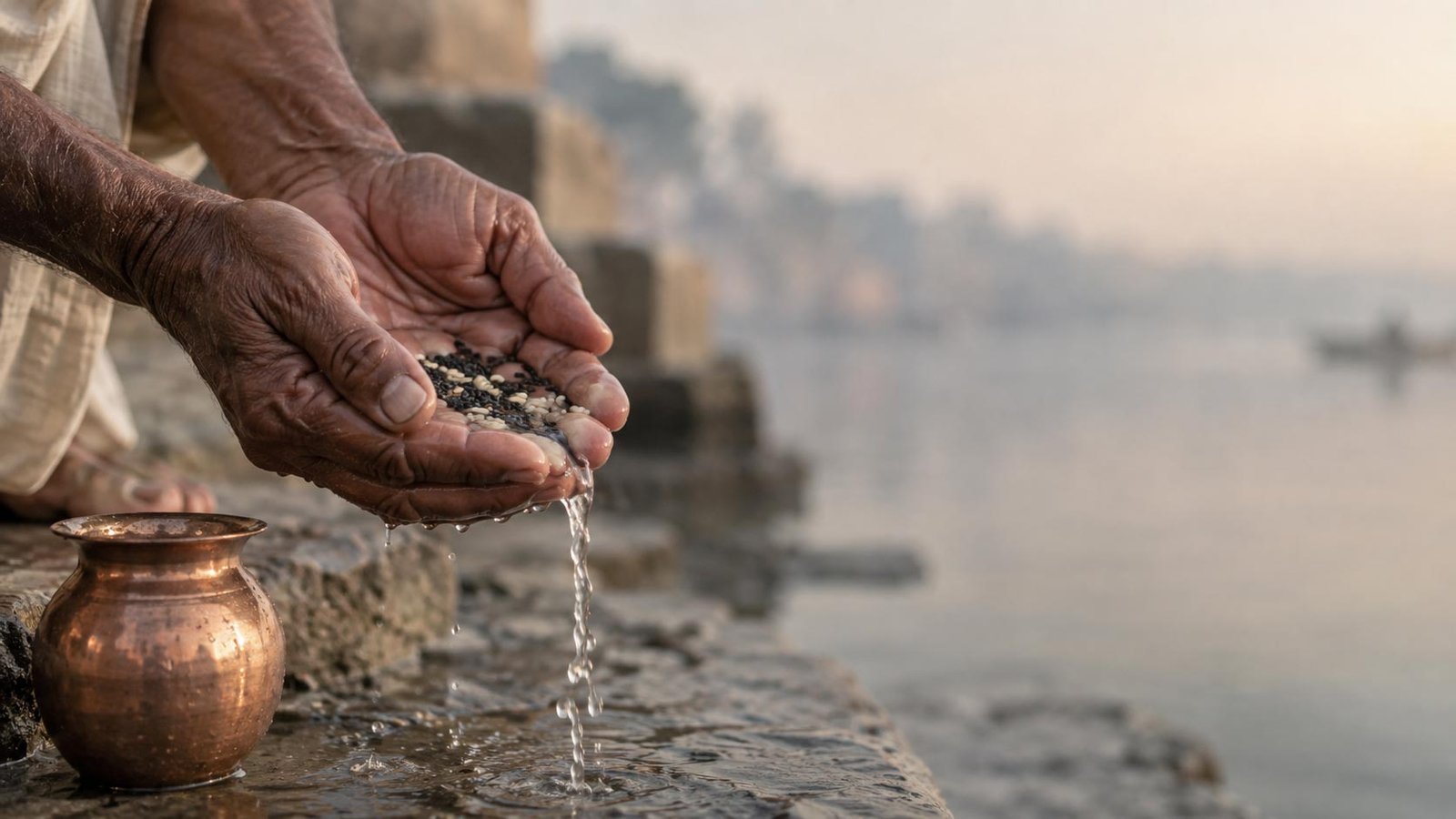
Honestly, you don’t need a big setup. Take a bath in the morning and sit facing south. Fill a copper or brass lota with water and put in some black til, a few grains of rice, and kusha if you can find it. Then say the name of each ancestor, with gotra if you know it, and let the water flow slowly from your joined palms over the thumb. Three times for each person.
That’s it. The rest is just talking to them in your heart.
One small thing about the hands. Water for the Pitrs is poured over the base of the thumb, which is called the pitru tirtha. Water for the gods goes over the fingertips. If you get it the other way round, don’t panic about it. Sit again the next morning and do it properly.
The food, and panchbali
Most homes make kheer, puri, a seasonal sabzi and something the departed person liked. That last part matters more than any rule. If your grandmother loved besan laddoo, make besan laddoo. Many families skip onion and garlic during these days, and cook in the first half of the day so the offering is ready by noon.
Before anyone in the house eats, five small portions are set aside. This is panchbali: one for the cow, one for the crow, one for the dog, one for ants or other small creatures, and one kept for a guest. The idea is simple enough. Nobody at the door is turned away on a day when we are asking our own to come and eat.
Crows are given special attention. In our tradition they are treated as the ones who carry the offering across. If a crow comes and eats, people take it as a good sign. If none comes, leave the food out anyway and let it go to whoever finds it. It still counts.
If you can go somewhere
Gaya is the big one. The Vishnupad temple and the banks of the Phalgu see lakhs of people during the Pitru Paksha mela, and pind daan here is considered complete in a way that few other places are. If you are planning it, go with the crowd in mind: reach a day early, keep your stay booked before you travel, start before sunrise, and fix the dakshina with the panda before the ritual begins rather than after. Gaya Junction is the nearest railhead and Patna airport is about three hours away.
Varanasi is the other great centre, with shradh at Pishachmochan Kund and along the ghats. Prayagraj draws people to the Sangam. Up in the hills, Brahma Kapal near Badrinath sits on the Alaknanda and is believed to end the need for further pind daan altogether. Pehowa in Haryana and Siddhpur in Gujarat are the smaller but deeply respected ones, and Siddhpur in particular is where people go for the shradh of a mother.
Can’t travel this year? That’s fine, and it always has been. The shastras are clear that tarpan done at home with a sincere heart is complete in itself. Do it at home, and if it helps you feel connected, open live darshan of Kashi or Gaya while you sit.
Sit with your ancestors, wherever you are. Live darshan runs all day, free.
The same fortnight, different names
In Bengal these days build up to Mahalaya, when people wake before dawn to listen to Mahishasuramardini on the radio and offer tarpan at the river. Mahalaya closes the ancestors’ fortnight and opens Durga Puja in the same breath.
In the south it is Mahalaya Amavasya or Mahalaya Paksham, and in Tamil Nadu and Kerala families perform tarpanam with an emphasis on the amavasya itself. Maharashtra calls the fortnight Pitru Paksha too but counts it in Bhadrapada. In Gujarat you will hear Sola Shraddha, the sixteen shraddhas. The customs around the edges differ, sometimes a lot. What sits at the centre is the same everywhere.
Observing it from another country
If you live abroad, the usual question is whether to follow Indian tithi or your local one. Most families follow the tithi as it falls where they are, because the ritual is tied to sunrise and the noon period of your own day. If you would rather follow the family’s timing back home, that is also accepted, and it is what many people do so that everyone is doing it together.
Black til, kusha and a copper vessel are not always easy to find. Til is usually available at any Indian store, and plain water in whatever clean vessel you own is enough if the rest isn’t. Nobody’s shradh has ever failed for want of the right metal.
A word about pitru dosh
You will find a great deal written about pitru dosh at this time of year, much of it designed to frighten you into paying for something. It is worth being plain here. In the traditional understanding, pitru dosh is described as the discontent that settles on a family that has forgotten its ancestors, and the remedy given in the texts is not expensive: remember them, offer water, feed someone who is hungry, and look after the elders who are still with you.
If someone tells you that a specific puja at a specific price is the only way to lift it, be careful. If your family astrologer suggests a remedy and you trust him, by all means follow it. But no one should feel that their parents’ peace depends on money they don’t have.
A few things people usually avoid
Traditionally, people don’t start anything new in these days: no griha pravesh, no engagements, no big purchases. Non-veg and alcohol are avoided, and the person doing shradh usually doesn’t cut hair or nails. On the other side, feeding someone hungry, donating til or clothes, or just sitting with the Gita for a while are all considered good.
One thing worth saying, because it comes up every year: none of this is a reason to postpone medical treatment, an exam, a job joining or anything that genuinely cannot wait. The restrictions are about celebration and new beginnings, not about stopping your life.
Quick questions people ask
Can I do it without a pandit?
Yes. Water, til and a sincere prayer is enough. A pandit helps if you want the full vidhi with mantras, but tarpan itself does not depend on one.
Can women do tarpan?
Families differ on this. Today many daughters and wives do it, especially when there’s no son. Sincerity matters more than the rule.
What if I miss the tithi?
Do it on Sarvapitru Amavasya, 10 October 2026. That day is meant for exactly this.
Do I need to fast on the shradh day?
The person performing shradh usually eats only after the offering and the panchbali are done, and keeps the meal simple. A full fast is not required.
My father is alive. Should I still observe Pitru Paksha?
Tarpan for a living parent is not done. But if you have lost a grandparent or another elder, their shradh can be performed, usually by the eldest son of that line. Many families also simply use these days to remember everyone and feed someone in their name.
Can shradh be done for someone who is not a blood relative?
Yes. A guru, a father-in-law, a friend who had no one to perform their rites — all of these are accepted. Offering on behalf of someone with no descendants is considered particularly worthy.
And the day after Amavasya, on 11 October, Navratri begins. We remember our ancestors first, then welcome Maa. Read the Navratri 2026 guide.
🙏