📜 About Shri Banke Bihari Mandir (Vrindavan)
The Loving Heart of Vrindavan and the Appearance of Bihari Ji
In the narrow devotional lanes of Vrindavan, where every turn carries the sound of “Radhe Radhe,” Shri Banke Bihari Mandir feels less like a temple and more like the living heart of Braj. Here, devotees do not only come to see an idol. They come to meet Thakur Shri Banke Bihari Ji Maharaj, the charming, playful, and love-filled form of Shri Krishna. The sacred story of this temple begins in Nidhivan, the mystical grove of Vrindavan, where the great saint Swami Shri Haridas Ji immersed himself in divine music, meditation, and nikunj bhakti. Tradition says that Swami Haridas Ji did not merely sing about Shri Krishna and Maa Radha. His singing was so full of prem that the divine couple Shyama Shyam appeared before him.
When devotees requested that such divine beauty should remain accessible for the world, the celestial couple left behind a dark, enchanting image, full of sweetness and mystery. This divine form came to be worshipped as Banke Bihari Ji. The word “Banke” refers to the threefold bending posture, or Tribhanga, and “Bihari” means the supreme enjoyer of Vrindavan’s divine groves. In this form, Shri Krishna is not distant, formal, or royal in a stiff way. He is intimate, playful, irresistible, and full of rasa. Initially, Bihari Ji was worshipped near the place of appearance in Nidhivan. Later, a grand temple was constructed in the 19th century CE, with the present temple traditionally associated with 1862 CE to 1864 CE. Even today, when a devotee enters the mandir, the feeling is simple and powerful. Bihari Ji has called, and the soul has arrived.
The Spiritual Meaning of Banke Bihari and Radha Krishna Prem
The beauty of Banke Bihari Ji lies in the fact that he is worshipped as the very essence of Radha Krishna prem. In many Vaishnav traditions, Shri Krishna is complete only with Maa Radha, because Radha is the supreme expression of devotion, love, and divine surrender. At Banke Bihari Mandir, devotees experience this united sweetness in a very personal way. Bihari Ji’s form is associated with the threefold bending posture of Shyamsundar, but the bhav inside the darshan carries the softness of Maa Radha’s love too. That is why many devotees feel that a single glance of Bihari Ji contains both Krishna’s attraction and Radha’s compassion.
The temple follows a tender seva tradition where Bihari Ji is treated like a beloved child and a playful lord. There are no loud temple bells inside the sanctum in the usual way because the mood is intimate and gentle. The darshan is also not continuous. The curtain is drawn again and again, and devotees wait for those few seconds when the curtain opens and Bihari Ji looks toward the gathering. This tradition is not only practical crowd management. It carries a deep devotional belief that if one looks at Bihari Ji continuously, the heart may become overwhelmed by his beauty, and Bihari Ji may even follow the devotee home out of love.
A beautiful Krishna mantra often remembered here is: Om Kleem Krishnaya Govindaya Gopijanavallabhaya Swaha. Its meaning is, “I bow to Shri Krishna, Govinda, the beloved of the gopis, the lord who attracts the heart through divine love.” In Banke Bihari Mandir, this mantra does not feel like a formal chant. It feels like the natural language of Vrindavan.
Swami Shri Haridas Ji, Nidhivan, and the Living Tradition
The soul of Banke Bihari Mandir cannot be understood without remembering Swami Shri Haridas Ji. He is revered as a great saint of Vrindavan, a master of divine music, and a rasik bhakta who lived in constant remembrance of Radha Krishna. The official temple tradition states that Swami Haridas Ji was born on Radha Ashtami in 1478 CE to Shri Ashudhir and Smt. Gangadevi. His spiritual lineage is connected with the sacred Braj tradition, and his life was dedicated to nikunj seva, the inner devotional service of the divine couple. His bhajans were not performances. They were offerings of the soul.
Nidhivan, where Bihari Ji appeared, remains one of the most mysterious and sacred places in Vrindavan. The trees there appear bent and intertwined, as if still bowing in the rasa of Radha Krishna. Devotees believe that the divine pastimes of Shri Krishna and Maa Radha are eternally present in Vrindavan, and Nidhivan is one of the most sensitive places connected with that bhav. From that sacred grove, the appearance of Banke Bihari Ji became a blessing for all devotees who cannot enter the deepest mysteries of nikunj leela but can still receive the grace of Bihari Ji through darshan.
The temple’s history also includes the devotion of the Goswami families, who carried forward the seva traditions of Swami Haridas Ji. When the new temple was built in the 19th century CE, it was created not as a monument of power, but as a house of seva. Even today, the daily rhythm of the temple revolves around Thakur Ji’s comfort, food, rest, adornment, and loving darshan. This is why the temple feels alive. Bihari Ji is not treated as a stone image. He is served as the living lord of Vrindavan.
Architecture, Atmosphere, and the Sacred Lanes of Vrindavan
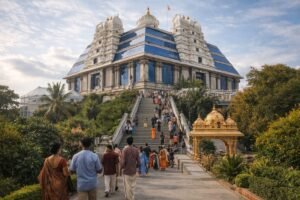
The architecture of Shri Banke Bihari Mandir carries the grace of North Indian and Rajasthani temple style. The structure is not as towering as some South Indian temples, but its spiritual force is enormous. The temple’s arched forms, carved details, inner courtyard, and old Braj atmosphere create a feeling of timeless devotion. The building was made to hold crowds of devotees, yet the sanctum remains intensely intimate. One does not feel far away from Bihari Ji. Even when the temple is crowded, the moment of darshan feels personally offered.
Outside the temple, the lanes of Vrindavan become a part of the pilgrimage. Shops selling tulsi malas, ladoos, peda, flowers, peacock feathers, small Krishna idols, and Radha Krishna pictures line the streets. Monkeys jump across rooftops, the sound of kirtan comes from nearby ashrams, and the repeated greeting “Radhe Radhe” turns ordinary movement into remembrance. The approach to the temple can be crowded, especially on weekends, Ekadashi, Purnima, Amavasya, Holi, Janmashtami, and the end-of-year holiday period. Yet for a devotee, even this crowd has meaning. It shows how deeply Bihari Ji belongs to people from every part of India and the world.
The temple is located near other sacred Vrindavan sites such as Radha Vallabh Temple and Nidhivan, and this gives the whole area a dense devotional energy. A devotee may enter the temple after walking through busy streets, but once the curtain opens and Bihari Ji is seen, the outer noise falls away. The architecture, the crowd, the flowers, the chants, and the ancient lanes all become one offering at his feet.
Festivals, Seva, and the Unique Joy of Braj
Shri Banke Bihari Mandir is always filled with celebration, because Braj itself lives in the mood of utsav. The official festival tradition includes many beloved days such as Akshaya Tritiya, Guru Purnima, Haryali Teej, Raksha Bandhan, Krishna Janmashtami, Nandotsav, Radha Ashtami, Sharad Purnima, Deepavali, Annakoot, Bihar Panchami, and the colourful Holi celebrations of Braj. Among these, Janmashtami is especially powerful because only on this day Mangla Aarti is traditionally performed for Bihari Ji. On ordinary days, early Mangla Aarti is not part of the usual public tradition because Thakur Ji is served in the tender mood of a child.
Holi at Banke Bihari Mandir is one of the most joyful spiritual experiences in India. Devotees gather as colours, flowers, bhajans, and the name of Radha Krishna fill the temple atmosphere. It is not merely a festival of colour. It is a celebration of divine play, where Shri Krishna’s loving mischief is remembered with laughter and devotion. Haryali Teej brings the Jhoola festival, when Thakur Ji is lovingly placed in swing seva. Akshaya Tritiya is special because devotees receive Charan Darshan in the morning and Sarvang Darshan in the evening. Sharad Purnima is also deeply cherished because Bihari Ji is traditionally seen with the flute, remembering the mood of Maha Raas.
The daily seva includes Shringar, Bhog, Rajbhog, evening darshan, and Shayan seva. The mood of worship is not rushed, even when the crowd is large. Every offering is made with love, and every darshan moment feels like a gift. Devotees who understand Braj bhav know that Bihari Ji is not won by show. He is won by prem.
Darshan Experience and Why Devotees Come
Darshan at Banke Bihari Mandir is unlike darshan anywhere else. The devotee stands in the crowd, often shoulder to shoulder with others, chanting “Radhe Radhe” and waiting for the curtain to open. Suddenly, the curtain moves, and for a few moments Bihari Ji appears. Some devotees fold their hands, some close their eyes, some cry softly, and some simply stare with a smile that cannot be explained. Then the curtain closes again, and the heart waits for the next glimpse. This rhythm of separation and meeting is the very mood of Vrindavan.
People come to Banke Bihari Ji for many reasons. Parents bring children for blessings, couples pray for harmony, students ask for success, business people seek auspicious beginnings, and countless devotees come simply because they miss Bihari Ji. The temple is known for fulfilling heartfelt prayers, but its deeper gift is not only wish fulfillment. It teaches the devotee how to love God not with fear, but with affection. Here Shri Krishna is not only the lord of the universe. He is the beloved of Braj, the playful child, the enchanting friend, and the one who steals the heart.
The famous prayer Radhe Radhe Shyam Mila De carries the feeling of many devotees. It means, “O Radha, please unite me with Shyam.” In Vrindavan, even Krishna is approached through Maa Radha’s mercy. That is why devotees say Radhe first, because Radha’s compassion opens the door to Bihari Ji’s darshan.
A Devotional Closing from the Heart
There are temples that impress the eyes, and there are temples that take hold of the heart. Shri Banke Bihari Mandir does both, but its true power is in the heart. A devotee may leave the temple after only a few moments of darshan, yet those moments keep returning in memory. The curtain opening, Bihari Ji’s dark enchanting form, the crowd crying “Radhe Radhe,” the fragrance of flowers, the sweetness of Braj, all of it stays within like prasad.
For LiveDarshanHub.com, this temple page should not only guide devotees with darshan timings, address, and travel details. It should help them feel the pull of Vrindavan before they arrive. May Thakur Shri Banke Bihari Ji Maharaj bless every devotee with prem bhakti, inner joy, protection, family happiness, and the grace of Maa Radha. Radhe Radhe.
श्री बाँके बिहारी जी महाराज सभी भक्तों को प्रेम, भक्ति, शांति और राधारानी की कृपा प्रदान करें। राधे राधे।
Darshan & Aarti Timings
🚪 Darshan Timings
🪔 Aarti Schedule
⭐ Best Time to Visit
⚠️ Timings may change on festivals, special occasions, or during temple renovation. Please verify with the temple before visiting.
Visitor Information
🗺️ Location & How to Reach
Agra Airport, about 75 km; Indira Gandhi International Airport, Delhi, about 160 km
Vrindavan Railway Station, about 3 km; Mathura Junction Railway Station, about 12 km
Vrindavan Bus Stand, about 2 km; Mathura Bus Stand, about 12 km
🧭 Detailed Directions
The nearest practical airport for devotees is Agra Airport, located about 75 km from Shri Banke Bihari Mandir. From Agra, devotees can reach Vrindavan by taxi or private vehicle in about 1.5 to 2.5 hours depending on traffic. Indira Gandhi International Airport in Delhi is another major option, about 160 km away, and is suitable for devotees coming from other Indian states or abroad. From Delhi, the journey to Vrindavan usually takes about 3 to 4.5 hours by road through the Yamuna Expressway or NH routes. During Holi, Janmashtami, and long holidays, travel time may increase because of heavy pilgrim movement.
By Train
Mathura Junction Railway Station is the most convenient major railhead, located about 12 km from the temple. It is well connected with Delhi, Agra, Jaipur, Lucknow, Mumbai, Kolkata, and many other cities. From Mathura Junction, devotees can take an auto rickshaw, taxi, e-rickshaw, or local bus to Vrindavan. Vrindavan Railway Station is closer, around 3 km from the temple, but it has more limited train connectivity, so many devotees prefer Mathura Junction for easier travel.
By Road
Vrindavan is well connected by road from Delhi, Agra, Mathura, Jaipur, and other nearby cities. From Mathura, the temple is about 12 km away and generally takes 25 to 40 minutes by taxi, auto, or e-rickshaw. From Delhi, the road journey is about 160 km and usually takes 3 to 4.5 hours. From Agra, the distance is about 75 km and travel time is around 1.5 to 2.5 hours. Roads near the temple become very crowded on weekends and festival days, so devotees should keep extra time for walking through the inner lanes.
By Local Transport
Inside Vrindavan, e-rickshaws, cycle rickshaws, autos, and walking are the most common ways to reach Banke Bihari Mandir. Many inner lanes near the temple are narrow and may have traffic restrictions, especially during Holi, Janmashtami, Ekadashi, Purnima, Amavasya, and year-end holidays. On major festival days, local administration often manages pedestrian routes, barricades, and crowd movement. Devotees should follow the official route instructions and avoid carrying heavy luggage near the temple.