📜 About Shree dwarka dhish (Dham)
The Kingdom That Disappeared Into the Sea, and the Temple That Did Not
If you want to understand why Dwarka matters, why it has mattered for three thousand years and will continue to matter long after we are gone, you need to start with the ending of the Mahabharata. Not the battle. The aftermath.
After the Kurukshetra war, after Duryodhana was dead and the Pandavas had won, after Gandhari had cursed Krishna that his Yadava clan would destroy itself just as he had let the Kauravas be destroyed, the curse came true. The Yadava clan, at a festival at Prabhasa (modern-day Somnath), fell into a drunken quarrel and killed each other. Krishna’s brother Balarama died. And Krishna, his divine work on earth complete, walked to the shore near Somnath and allowed a hunter named Jara, who mistook his foot for a deer, to shoot an arrow into his heel. He forgave Jara, sat under a tree, and left his mortal body.
He then sent word to the Pandava king Arjuna: Come to Dwarka. Bring the women and children and the remaining Yadavas to safety. And then leave. Because the sea is coming.
Arjuna came. He took the survivors north to what is now the Kurukshetra region. And the day after they left — exactly as Krishna had said, the sea rose and swallowed Dwarka. The golden city, with its magnificent palaces and its 900,000 royal families and its harbour full of ships, slipped beneath the waves without a trace.
The Mahabharata was written approximately 3,000 years ago. In the 1980s and again in the 2000s, marine archaeologists diving off the coast of modern Dwarka found the ruins of an ancient city on the seabed — stone walls, pillars, what appear to be the foundations of large structures, lying at a depth of about 30 to 40 feet, about 500 metres offshore. The dating of the artefacts corresponds roughly to the period traditionally associated with Krishna’s life.
This is not proof of anything specific. Archaeology is rarely that clean. But it is something. Something that sits between mythology and history in that uncomfortable, exciting, strangely sacred space where the most important truths often live.
And above the sea, on the shore where the Gomati River meets the ocean, the Dwarkadhish Temple stands. Not where Krishna’s palace was. But where is the memory of Krishna’s palace is. Where the devotion that outlasted the palace is. Where the faith that survived the submersion is.
Krishna of Dwarka — Not the Flute-Player but the King
Most people’s image of Krishna comes from Vrindavan, the young cowherd, the flute-player, the one who dances with the Gopis in the moonlight, the beautiful, elusive, playful deity who makes the heart ache with love. That Krishna is real. That Krishna is beloved. But that is not the Krishna of Dwarka.
The Krishna of Dwarka is older. He has put down the flute. He is a king, a statesman, a strategist, a husband, husband to Rukmini, to Satyabhama, to 16,108 wives in total (each of whom, according to tradition, he rescued from captivity and married to restore their honour). He is the architect of the Kurukshetra war, not because he wanted war, but because he understood that some conflicts cannot be resolved without it. He is the friend who told Arjuna the truth on the battlefield when the truth was the hardest thing to hear.
Dwarka Krishna is the grown-up version of Vrindavan Krishna. The one who carried the weight of the world with the same ease that the young one carried a flute. And the Dwarkadhish Temple, the Lord of Dwarka, honours this grown-up Krishna, this king-god, this statesman of the cosmos.
There is a particular kind of devotion that this Krishna inspires. Less the ache of separation, more the steadiness of love that has been tested and survived. Less the yearning of the Gopi, more the loyalty of Rukmini, who followed Krishna across the country because she believed in him completely, who built her life at his side, who was present in the kingdom and in the court and in the ordinary complicated dailiness of a life lived with a god who was also a man.
Come to Dwarka for that Krishna. Come for the king. Come for the one who stayed.
The Temple — Five Storeys, Seventy-Two Metres, and a Flag That Never Stops Flying
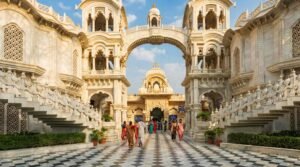
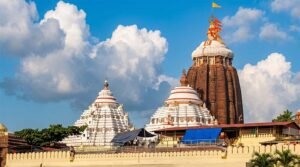
The Dwarkadhish Temple, also called Jagat Mandir (the Temple of the Universe), is one of the architectural masterpieces of medieval Hindu temple-building. The current structure is primarily from the 15th–16th century, though the temple has been rebuilt and restored multiple times over the centuries, with the earliest reference to a temple at this site dating to the 2nd century BC.
The temple is five storeys tall, rising 78.3 metres (257 feet) above the ground — one of the tallest temple spires in India. The shikhara is built in the Chalukya style, with the characteristic curvilinear profile of Gujarati temple architecture, and is decorated with 72 pillar carvings of extraordinary quality. The entire complex is surrounded by a fortified wall with separate entry and exit points, and the approach through the old town of Dwarka, along narrow lanes lined with shops selling conch shells, flowers, and devotional items, is itself one of the great pilgrimage experiences of western India.
The most iconic feature of the Dwarkadhish Temple is its flag. Flying from the top of the 78-metre spire, the flag is changed five times every day. Each flag is exactly 52 yards long, a figure that represents the 52 yards in which Dwarka is divided according to tradition. The flags are made of cloth in the colours associated with Lord Vishnu, yellow, saffron, and white, and each new flag is sent up by a priest who climbs the external stairway to the very top of the spire. The sight of this flag, clearly visible from the sea, has guided sailors home for centuries. Fishermen from Dwarka say that when they can see the flag from their boats, they know they are safe.
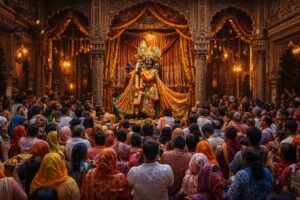
Inside the main sanctum, Lord Krishna is worshipped as Dwarkadhish, the Lord of Dwarka, in a form with four arms, holding a conch, a chakra, a mace, and a lotus. The idol is made of black limestone. The sanctum is surrounded by several smaller shrines, including those of Rukmini, Balarama, Pradyumna, Aniruddha, Jambavati, and Satyabhama, bringing the entire royal court of Dwarka into the temple complex as if the palace itself had been preserved in sacred form.
Gomati Ghat — Where the River Meets the Sea
The approach to the Dwarkadhish Temple from the south takes you through the Gomati Ghat, the sacred ghats where the Gomati River meets the Arabian Sea. This is one of the most sacred bathing points in Gujarat, and pilgrims bathe here before entering the temple, as the tradition requires. The early morning at Gomati Ghat has a particular quality: the sea wind, the sound of conches from the temple above, the golden light on the water, the fishermen already at work on the horizon, that is simultaneously deeply local and deeply sacred in the way that only places where ordinary life and extraordinary faith have coexisted for centuries can be.
The ghat area also contains several important subsidiary temples and shrines, the Samudra Narayana Temple (sea deity), the Rukmini Devi Temple (about 2.5 km from the main temple, in a separate, exquisitely carved structure), and various shrines to the associates and wives of Krishna.
Beyt Dwarka — The Island Where Krishna Actually Lived
If the mainland Dwarkadhish Temple is where you worship the memory of Krishna’s city, then Beyt Dwarka (also called Shankhodwar or Bet Dwarka) is where you go to be in it.
Beyt Dwarka is a small island about 30 kilometres from the main Dwarka town, reached by a short ferry ride from the port of Okha. According to tradition, this island, not the mainland, is where Krishna’s actual palace stood. Where he lived with Rukmini and Satyabhama. Where the Yadavas had their homes and their court. The current Beyt Dwarka contains several important temples, including the Dwarkadhish Temple (a separate, older shrine), the Rukmini Temple, and the Hanuman Temple (where Hanuman himself is said to have visited during the Dwapara Yuga).
The ferry ride to Beyt Dwarka is itself an experience; crossing the stretch of shallow water between Okha port and the island, with the Gulf of Khambhat shimmering around you, is a journey that feels like you are crossing time as much as water. On the island, the pace slows. The shrines are smaller and quieter than the mainland temple. The sense of stepping into an older, more intimate layer of the sacred is stronger here than almost anywhere else in western India.
The Panch Teertha Tradition
A complete pilgrimage to Dwarka involves not just one temple but a circuit of five sacred spots — called the Panch Teertha (five holy sites):
- Gomati Ghat — Sacred bath at the river-sea confluence
- Dwarkadhish Temple — The main temple and Char Dham
- Rukmini Devi Temple — Temple of Krishna’s principal wife, 2.5 km away
- Nageshwar Jyotirlinga (18 km) — The tenth Jyotirlinga, counted as part of the Dwarka circuit
- Beyt Dwarka (30 km) — The island of Krishna’s actual residence
Pilgrims who complete the full Panch Teertha, which can be done in two days with reasonable planning, receive the full merit of the Dwarka pilgrimage. The combination of the Char Dham, the Jyotirlinga, and the associated temples in this single circuit makes Dwarka one of the most densely sacred pilgrimage destinations in India.
Why Rukmini’s Temple Is 2.5 Kilometres Away From Krishna’s
Here is a story that most people miss, and it is one of the most charming details in all of Dwarka’s mythology.
The Rukmini Devi Temple stands 2.5 kilometres from the Dwarkadhish Temple. Why are the husband and wife in separate temples, so far apart?
The legend says: the sage Durvasa, famously short-tempered and sensitive to insult, was once invited to dinner by Krishna and Rukmini. As they were travelling to the dinner venue, Rukmini felt thirsty. In a moment of wifely casualness, she asked Krishna, who was pulling the chariot himself that day, to stop for water. Krishna stopped and produced water miraculously. But Durvasa, walking behind the chariot, was left in the dust when Krishna stopped suddenly and was deeply offended.
Durvasa cursed Rukmini: “You will be separated from your husband and live at a distance from him forever.”
And so the Rukmini Devi Temple, one of the most beautifully carved Vaishnava temples in Gujarat, with remarkable 12th-century friezes depicting scenes from the Rukmini-Haran (the story of Krishna’s elopement with Rukmini), stands 2.5 kilometres from the Dwarkadhish Temple. Husband and wife, temple and temple, separated by a curse and a stretch of Saurashtra road, forever gazing in each other’s direction.
Pilgrims who visit Dwarka always visit the Rukmini Temple separately, walking or taking a rickshaw the 2.5 kilometres, as if honouring the devotion of a wife who loved her husband across a distance imposed by a sage’s bad temper. That too is a kind of prayer.
Aarti & Daily Rituals
The Dwarkadhish Temple conducts its rituals according to the Vallabhacharya sampradaya tradition — the devotional school established by the 15th-century saint Vallabhacharya, who taught the path of pure love (Shuddhadvaita) and whose descendants have served as the chief priests of Dwarka for centuries. The rituals are elaborate, colourful, and deeply aesthetic, reflecting Vallabhacharya’s teaching that God should be worshipped with the most beautiful things the devotee can offer:
- Mangala Aarti: 6:30 AM — The earliest aarti; the deity is awakened with lamps, incense, and devotional songs. The Mangala darshan — when the Lord is seen in his early-morning, just-awakened state — is considered the most intimate and most auspicious.
- Shringar Darshan: 7:30 AM — The deity is elaborately decorated in jewels, silk, and fresh flowers for the morning
- Gwal Darshan: 9:00 AM — The Lord is shown as the cowherd, a nod to his Vrindavan identity
- Rajbhog Darshan: 12:00 PM — The midday royal offering; the most elaborate meal of the day
- Uthapan Darshan: 5:30 PM — The deity wakes from his midday rest
- Sandhya Aarti: 7:30 PM — Evening aarti; among the most beautiful — the golden light on the stone temple and the sound of bells and conches carrying over the sea
- Shayan Darshan: 8:30 PM — The Lord is put to rest for the night
Major Festivals
- Janmashtami: The grandest festival, the birthday of Lord Krishna. Dwarka celebrates Janmashtami with extraordinary energy; the entire city illuminates, midnight abhishek, massive processions, and continuous bhajans from dusk to dawn. This is the most important night of the Dwarka calendar.
- Holi: Dwarka celebrates Holi with the specific tradition of the Dwarka region — Lathmar Holi in the surrounding villages and a grand celebration at the temple itself
- Dwadashi (Ekadashi + 1): Every Ekadashi is important for Vaishnava temples; Dwarka celebrates each one with special puja and significantly higher darshan footfall
- Annakut / Govardhan Puja (day after Diwali): Massive offering to Krishna; mountains of food are prepared and offered to the deity before being distributed as prasad
- Diwali: The entire Saurashtra coast celebrates; Dwarka specifically has special fireworks over the sea and illumination of the temple spire
- Navratri: Nine days of devotional programs; particularly important in Gujarat, where Navratri is the state’s greatest cultural-religious event
How to Reach Dwarka
By Air: The nearest airport is Jamnagar Airport (137 km from Dwarka), with flights from Mumbai and Ahmedabad. Many pilgrims also fly to Rajkot Airport (220 km), which has better connectivity to major Indian cities.
By Train: Dwarka Railway Station is right in the heart of town, 1 km from the temple. The station is on the Rajkot–Okha broad gauge line. Express trains from Ahmedabad (Saurashtra Mail), Mumbai (Saurashtra Express, Bandra-Okha Express), and Jamnagar connect directly to Dwarka. The overnight train from Ahmedabad, arriving in the early morning, so your first view of Dwarka is at sunrise, is the most atmospheric way to arrive.
By Road: Dwarka is 450 km from Ahmedabad, 220 km from Rajkot, and 137 km from Jamnagar. NH-947 connects Dwarka to the national highway network. Regular GSRTC buses from Ahmedabad, Rajkot, and Jamnagar. The drive from Rajkot through the flat, open Saurashtra landscape has its own quiet grandeur, and the moment when the sea appears, and the temple spire rises over the horizon is genuinely memorable.
Essential Tips
- 🌅 Arrive before sunrise: The Gomati Ghat at dawn, with the sea turning gold and the temple bells beginning above you, is the definitive Dwarka experience.
- 🚢 Beyt Dwarka ferry: The last ferry from Okha to Beyt Dwarka leaves around 6 PM. Plan accordingly — the island is worth a full half-day.
- 🎉 Janmashtami timing: If you can visit during Janmashtami (August), the experience is transformative. Book accommodation months in advance.
- 🧭 Panch Teertha circuit: Allow minimum 2 days — Day 1 for Dwarkadhish, Gomati Ghat, and Rukmini Temple; Day 2 for Nageshwar and Beyt Dwarka.
- 🌡️ Weather: Coastal Gujarat is hot and humid April–June. Best months: October–March. Monsoon (July–September) brings beautiful grey sea but occasional flooding on coastal roads.
Nearby Attractions
- Beyt Dwarka Island (30 km) — Krishna’s actual residence; ferry from Okha
- Rukmini Devi Temple (2.5 km) — Exquisitely carved 12th century temple
- Nageshwar Jyotirlinga (18 km) — Tenth Jyotirlinga; part of Panch Teertha
- Gopi Talav (20 km) — Sacred pond; extraordinary devotional atmosphere
- Lighthouse, Dwarka — Views of the Gulf of Khambhat
- Porbandar (100 km) — Mahatma Gandhi’s birthplace
- Somnath (235 km) — First Jyotirlinga; easy overnight trip
- Gir National Park (200 km) — Last Asiatic lions
Why Dwarka Is the Char Dham of the Heart
Badrinath gives you the stillness of the mountains. Rameshwaram gives you the humility of Rama. Jagannath Puri gives you the ecstasy of the crowd. But Dwarka gives you something more intimate, more personal, more quietly devastating than any of them.
Dwarka gives you loss.
Not a tragic loss, the loss that comes with completion. The kind of loss that happens when something beautiful ends not because it failed but because it fulfilled its purpose completely. Krishna’s city did not fall to an enemy. It was not abandoned out of neglect. It was swallowed by the sea because its time was complete. Because Krishna himself walked to the shore and let go. Because the greatest act of a god who had given everything was, finally, to leave.
Standing on the Gomati Ghat with the sea in front of you, knowing what lies beneath the water, watching the flag on the temple spire 78 metres above you whipping in the coastal wind, you feel, if you are paying attention, something very specific. Not grief. Not nostalgia. A kind of reverence for the things that were beautiful and are now gone, and for the things that are beautiful precisely because they know they will one day be gone.
That flag will keep flying after every one of us is dust. That spire will still be visible from the sea long after the fishermen whose fathers guided by it are forgotten. And beneath the waves, in the sediment of the Arabian Sea, the walls of a golden city will keep lying in their patient darkness, waiting.
For what? No one knows. But they are waiting.
And the temple above them keeps standing. As it always has. As it always will.
🗿 Temple Murti / Statue
द्वारकाधीश — द्वारका के स्वामी भगवान कृष्ण, गुजरात
Darshan & Aarti Timings
🚪 Darshan Timings
🪔 Aarti Schedule
⭐ Best Time to Visit
⚠️ Timings may change on festivals, special occasions, or during temple renovation. Please verify with the temple before visiting.
Visitor Information
🗺️ Location & How to Reach
Jamnagar Airport (137 km) | Rajkot Airport (220 km)
Dwarka Railway Station (1 km from temple)
Dwarka Bus Stand (500 m)