📜 About Grishneshwar Jyotirlinga Temple
The Last Light — And Why It Matters That It Is Last
There is a particular grace that comes with endings. Not sadness, though endings carry that too, but a quality of completion, of arrival, of having finally reached the place that all the previous places were pointing toward. The twelfth chapter of a great book. The last note of a symphony. The final bead on a mala.
Grishneshwar is that last bead.
And what is beautiful about it, what is almost unbearably apt, is that this final Jyotirlinga, this last dwelling-place of Shiva’s divine light on earth, is not a temple of warfare or cosmic power or geological wonder. It is a temple that was born from love. From grief. From the simple, human, agonizing experience of losing a child, and from what happened when a devoted woman refused to stop believing even in the face of that loss.
The story of Grishneshwar is not a story about gods and demons. It is a story about us.
The Story — Two Sisters, One Grief, and Shiva’s Promise
In the ancient past, in a village on the banks of the Deva River near the Ellora hills, there lived two sisters. The elder was named Sudeha. The younger was named Ghushma (also written as Kusuma or Ghrishneshwari in some traditions).
Sudeha had married a kind man named Sudharm. But years passed and Sudeha could not have children. In the society of the time, this was a source of immense personal suffering, not just social pressure, but a genuine, aching grief for a woman who longed for a child. Sudeha, unable to bear children herself, convinced her husband to take her younger sister Ghushma as a second wife.
Ghushma was a deeply devoted woman, a Shiva bhakta who performed extraordinary daily rituals. Every single day, she would make 101 Shivalingas out of clay, worship them with full devotion, and then immerse them in the nearby lake. Day after day, month after month, year after year, this was her practice. Unwavering. Joyful. Complete.
And Lord Shiva blessed her. Ghushma and Sudharm had a son, a beautiful, healthy boy who grew into a fine young man. But this blessing became the source of Sudeha’s suffering in a new way. As the years passed and Ghushma’s son flourished, Sudeha’s grief transformed into something darker: jealousy. Not the petty kind, the deep, corrosive kind that comes when someone else has the very thing your heart has ached for since the beginning.
One night, in a moment of darkness that she could not pull herself back from, Sudeha killed Ghushma’s son while he slept. And to hide the evidence, she threw his body into the same lake where Ghushma immersed her Shivalingas every morning.
The next morning, Ghushma’s daughter-in-law woke to find her husband gone. The family searched. Eventually, they realised what had happened. The grief in that house, and the anger toward Sudeha, was immeasurable.
And Ghushma went to the lake. Not to mourn. Not to rage. Not to confront. She went to the lake and she did what she did every morning: she made her 101 Shivalingas. She worshipped them. She immersed them. With her hands shaking and her heart in pieces, she kept doing the one thing she had always done. She kept offering. She kept believing.
Lord Shiva appeared. He had restored Ghushma’s son, the young man emerged from the lake alive and unharmed. And Shiva turned to Ghushma and said: “Ask me for a boon. Whatever you desire, I will grant it.”
What Ghushma asked for, in this moment, with her son alive before her and her sister’s terrible act behind her, is what makes this story extraordinary. She did not ask for justice. She did not ask for punishment for Sudeha. She asked Shiva to forgive her sister. To restore Sudeha to her original self. To release Sudeha from whatever darkness had consumed her.
Shiva was deeply moved. He asked Ghushma to name the Jyotirlinga, and Ghushma gave it her own name. Ghushma became Ghrishneshwar, the Lord who is Ghushma’s God. The deity who answered when she called. The Shiva who restored her son and received, in return, nothing but forgiveness.
That is the last Jyotirlinga. Born not from cosmic warfare. Born from the specific, irreducible, indestructible power of a woman who kept making her offering even on the worst morning of her life.
The Temple — Red Stone, Ahilyabai, and the Touch of Royalty
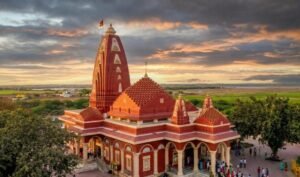
The Grishneshwar Temple you see today is not an ancient structure in the visual sense, unlike Kedarnath’s thousand-year-old grey stone walls or Trimbakeshwar’s dark Hemadpanthi blocks. The current temple was rebuilt in the 18th century by the same extraordinary queen who built so much of Hindu India: Maharani Ahilyabai Holkar of Indore.
This is the third Jyotirlinga she rebuilt, she also reconstructed Somnath and Kashi Vishwanath. And in some ways, Grishneshwar is where Ahilyabai’s signature style is most fully expressed. The temple is built in warm red Shilahar stone, a reddish sandstone that glows in the afternoon sun, making it visually very different from the dark stone temples of the Deccan. The entire temple is richly carved: the outer walls are covered in friezes depicting scenes from the Puranas, celestial apsaras, floral patterns, and episodes from the Ramayana and Mahabharata. It is, in the best sense, a temple that looks like it was built by someone who loved beauty and believed that the divine deserves only the most beautiful things.
The main shikhara rises 24 metres above the sanctum, not the tallest among Jyotirlingas, but proportionate and elegant, with the Nagara-style tower’s upward movement creating a sense of aspiration that matches the devotional energy of the temple.
Inside, the corridors and mandapams are richly decorated with painted sculptures, and the stone columns of the main hall are carved with exceptional detail. The Grishneshwar Jyotirlinga in the inner sanctum is a smooth, east-facing linga, unlike the south-facing Dakshinamukhi lingas of Mahakaleshwar and Nageshwar. The east-facing aspect is significant: east is the direction of the rising sun, of new beginnings, of the dawn that comes after every darkness. And this is, after all, a temple that was born on one of the worst mornings imaginable, and turned it into an eternal sacred site.
The Goddess Parvati is worshipped in the temple as Ghushma, not as the cosmic consort of Shiva, but as the historical-mythological devotee who gave the temple its name. This is rare in Jyotirlinga temples and gives Grishneshwar a quality of intimacy, the sense that the person who first prayed here is still present, still acknowledged, still honoured.
Next Door — The Caves That Changed the World
500 metres. That is the distance between the Grishneshwar Jyotirlinga Temple and the first caves of Ellora.
Think about what that means. For over 600 years, from approximately the 6th to the 11th century AD, sculptors, monks, artists, and craftspeople came to this basalt cliff in the Deccan and carved directly into the rock. Not buildings that were placed on the ground. Buildings that were excavated from solid stone, each pillar, each ceiling, each deity, each narrative panel, each doorway carved out of the living rock rather than assembled from separate pieces. Thirty-four such structures. Twelve Buddhist, seventeen Hindu, five Jain, three different religious traditions side by side in the same cliff face, representing a period of artistic and religious production that has no equal anywhere in the world.
The most famous of the Ellora caves is Cave 16, the Kailasa Temple. Built by the Rashtrakuta king Krishna I in the 8th century, the Kailasa Temple is not a cave temple in the conventional sense. It is a freestanding temple, carved entirely from a single rock. Imagine a temple the size of the Parthenon, with towering gopurams, elaborate mandapams, elephant sculptures flanking the base, and a shikhara that rises 30 metres above the ground, and then imagine that the entire thing was carved from a single piece of rock, starting from the top and working downward, over a period estimated at 100-150 years. The scale of human ambition and artistic mastery required for the Kailasa Temple is almost beyond comprehension. It is generally considered the greatest single work of rock-cut architecture ever created by human beings.
And it sits 500 metres from the last Jyotirlinga.
The combination of Grishneshwar and Ellora in a single pilgrimage is one of the most extraordinary combinations in all of Indian travel, the smallest, most intimate, most human of the Jyotirlingas sitting next door to one of the most superhuman artistic achievements in history. Come for the prayer. Stay for the stone. Be changed by both.
Ajanta Caves — An Hour Away
While you are in this part of Maharashtra, you cannot, must not, leave without visiting the Ajanta Caves, approximately 100 km from Ellora. If Ellora is the world’s greatest collection of rock-cut architecture, Ajanta is the world’s greatest collection of ancient painted art. Twenty-nine Buddhist cave monasteries, carved between the 2nd century BC and the 6th century AD, with walls and ceilings covered in murals depicting the life of the Buddha and scenes from the Jataka tales in colours so vibrant, cobalt, ochre, lapis lazuli, that they still sing after 1,500 years. The UNESCO site was accidentally rediscovered by a British hunting party in 1819 after having been completely forgotten for over a thousand years. The first painting they found, of a Bodhisattva holding a lotus in a posture of infinite compassion, is considered one of the most beautiful painted images in the world.
Grishneshwar, Ellora, and Ajanta together form one of the most extraordinary cultural and spiritual itineraries available to any traveller on earth. It is the kind of combination that changes how you see things, permanently and irreversibly.
Aarti & Daily Rituals
The Grishneshwar Temple follows the traditional Shaiva ritual schedule, conducted with a quiet regularity that reflects the temple’s intimate, gentle character, less about spectacle and more about steady, daily devotion:
- Kakad Aarti (Pre-dawn): 5:30 AM, The earliest aarti. The red stone temple in the grey pre-dawn light, the lamps being lit inside, the first bells of the day echoing over the Verul village, this is one of those moments that rewards the pilgrim who arrives the night before and rises before sunrise.
- Panchamrit Abhishek: 6:30 AM, The sacred bathing of the linga with five substances. The east-facing linga receives the first light of the rising sun through the eastern doorway during the abhishek, a detail that the priests point out with quiet pride.
- Madhyanha Aarti: 12:00 PM — Midday aarti and bhog offering
- Sandhya Aarti: 7:30 PM — The evening aarti, when the red stone of the temple catches the last light of the day and the lamps inside begin to matter more than the sunlight
- Shayan Aarti: 9:00 PM — The final aarti of the day. The last prayer. The last light. For pilgrims who have made the full circuit of all twelve Jyotirlingas and are ending here — as the tradition prescribes — this final shayan aarti at Grishneshwar carries a weight that is difficult to describe. Something completes.
Major Festivals
- Maha Shivaratri: The biggest event — the village fills, the temple glows with thousands of lamps, and continuous puja runs from dusk to dawn. The combination of Shivaratri at Grishneshwar and a dawn visit to Ellora the next morning is one of the most memorable 24-hour periods a pilgrim can spend in Maharashtra.
- Shravan Month: The entire month sees elevated footfall and daily special pujas; every Monday is especially crowded
- Navratri: Nine-day festival with special pujas for Goddess Ghushma (Parvati) — the human devotee who gave her name to the deity is honoured with particular devotion during Navratri
- Grishneshwar Yatra (Annual fair): The annual fair at the temple, held during specific months, brings the entire surrounding region together in a celebration that has been happening continuously for centuries
- Kartik Purnima: Sacred lamp offering and grand darshan
How to Reach Grishneshwar
By Air: The nearest airport is Aurangabad Airport (Dr. Babasaheb Ambedkar International Airport), just 30 km from Grishneshwar. Aurangabad has direct flights from Mumbai, Delhi, Hyderabad, Bengaluru, and Jaipur. From the airport, taxis reach Ellora-Verul in about 30–40 minutes.
By Train: Aurangabad Railway Station is the nearest major station, 30 km from the temple. Aurangabad is connected to Mumbai (Devagiri Express, overnight, highly recommended), Pune, Hyderabad, and Nasik. From Aurangabad station, buses and taxis to Ellora/Grishneshwar.
By Road: Grishneshwar is 30 km from Aurangabad, 100 km from Jalgaon (Ajanta gateway), and 240 km from Pune. MSRTC buses run from Aurangabad to Ellora village every 30 minutes. The drive from Aurangabad through the Deccan countryside — past orange orchards and rocky outcrops — is an excellent beginning to the pilgrimage.
The Perfect Itinerary — How to Do Justice to This Place
- Day 1 Afternoon: Arrive at Aurangabad. Check in. Drive to Grishneshwar for evening Sandhya Aarti (7:30 PM). First darshan. Walk through the temple in the lamp-lit evening. Return to Aurangabad.
- Day 2 Morning: Rise before dawn. Reach Grishneshwar for Kakad Aarti (5:30 AM). Full darshan including Panchamrit Abhishek. Then walk 500 metres to Ellora Caves. Spend the morning at Ellora — minimum 3 hours; give yourself 4–5 if you can. The Kailasa Temple (Cave 16) alone requires an hour of just standing still and looking.
- Day 3: Day trip to Ajanta Caves (100 km from Aurangabad). Full day. Come back changed.
Nearby Attractions
- Ellora Caves (500 m) — UNESCO World Heritage; 34 rock-cut temples; Kailasa Temple (Cave 16) — do not miss under any circumstances
- Aurangabad Caves (30 km) — Smaller but exquisite Buddhist rock-cut caves in the hills above the city
- Bibi Ka Maqbara (30 km) — Called the Taj of the Deccan; built by Aurangzeb’s son for his mother; impressive Mughal architecture
- Daulatabad Fort (13 km) — One of the most impregnable medieval forts in India; built on a volcanic plug; fascinating history
- Ajanta Caves (100 km) — UNESCO; world’s finest ancient painted murals; 29 Buddhist cave monasteries
- Pitalkhora Caves (78 km) — Lesser-known Buddhist caves older than Ajanta; waterfall nearby
- Trimbakeshwar (125 km) — Eighth Jyotirlinga; easy day trip
- Shirdi (130 km) — Sai Baba temple; popular combined pilgrimage from Aurangabad
Why Grishneshwar Is the Perfect Ending
We started this journey at Somnath — a temple on the edge of the Arabian Sea, destroyed and rebuilt seventeen times, standing as a monument to the indestructibility of faith. We climbed to Kedarnath at 3,583 metres in the Himalayas, walked through the forest to Bhimashankar, bathed in the Narmada at Omkareshwar, stood in the golden lanes of Varanasi, and finally knelt with Rama on the shore at Rameshwaram.
Twelve temples. Twelve forms of Shiva’s divine light. Twelve different answers to the question: what is sacred, and how do we find it?
And the last answer — Grishneshwar’s answer — is the simplest and perhaps the most important.
It is not found in cosmic warfare. It is not found on mountain peaks or at the confluence of holy rivers. It is not found in gold spires or a thousand-pillar corridors or the world’s longest temple hall.
It is found in a woman by a lake, on the worst morning of her life, making her offering anyway.
It is found in the hands that keep shaping the clay even when everything else has fallen apart. In the prayer that continues even when there is no apparent reason to continue. In the forgiveness that extends even to the person who caused the grief.
The twelve Jyotirlingas begin with the indestructibility of stone and faith at Somnath, and they end with the indestructibility of the human heart at Grishneshwar. They begin with a temple that cannot be destroyed by any king and they end with a devotion that cannot be destroyed by any tragedy.
That is the complete teaching of the Jyotirlingas. That is what you carry home.
Do your 101 offerings. Make them beautifully. Immerse them with love. And when the worst morning comes — because it comes for all of us — go to the lake anyway.
Go to the lake anyway.
🗿 Temple Murti / Statue
घृष्णेश्वर ज्योतिर्लिंग — बारहवाँ और अंतिम ज्योतिर्लिंग, एलोरा, औरंगाबाद
Darshan & Aarti Timings
🚪 Darshan Timings
🪔 Aarti Schedule
⭐ Best Time to Visit
⚠️ Timings may change on festivals, special occasions, or during temple renovation. Please verify with the temple before visiting.
Visitor Information
🗺️ Location & How to Reach
Aurangabad Airport / Dr. Babasaheb Ambedkar International Airport (30 km)
Aurangabad Railway Station (30 km)
Ellora Bus Stand (500 m from temple) | MSRTC from Aurangabad every 30 mins