📜 About Bahula Shaktipeeth, Ketugram
The Sacred Shakti Peeth of Maa Bahula in Ketugram
In the peaceful village setting of Ketugram in Purba Bardhaman, Bahula Shaktipeeth stands as a quiet but deeply powerful seat of Maa’s grace. This is not a temple that overwhelms the devotee with huge crowds or royal display. Its strength lies in its simplicity, its old-world Bengal atmosphere, and the feeling that Maa is very near to those who come with faith. The temple is dedicated to Maa Bahula, who is worshipped as a form of Maa Sati, Maa Parvati, and the eternal Adi Shakti. For devotees of Shakti, every Shakti Peeth is not merely a place on a map. It is a point where the cosmic body of the Divine Mother touched the earth and made that land sacred forever.
According to the most widely followed local tradition, this is the holy place where Maa Sati’s left arm, or bahu, fell after Lord Vishnu used the Sudarshan Chakra to calm Lord Shiva’s grief-filled cosmic dance. Because the arm is associated with strength, protection, action, care, and the mother’s embrace, Bahula Shaktipeeth carries a very tender spiritual meaning. Devotees often feel that Maa Bahula gives the strength to carry life’s burdens and the compassion to heal what is broken within the heart. Some traditions mention variations about the exact body part, but the living faith of Ketugram strongly remembers Maa Bahula as the Shakti of the fallen arm. The name Bahula is also understood as abundant, generous, and full, reminding devotees that the Mother’s grace never comes in small measure.
The Legend of Sati, Shiva, and the Birth of the Shakti Peethas
The sacredness of Bahula Shaktipeeth begins with the ancient and emotional story of Maa Sati and Lord Shiva. Sati, the daughter of King Daksha, chose Lord Shiva as her divine husband, but Daksha could not accept Shiva’s unconventional and ascetic form. When Daksha organized a great yajna and did not invite Shiva with proper respect, Maa Sati went there and saw her beloved Lord insulted. Unable to bear that pain, she gave up her body in the fire of yogic sacrifice. When Lord Shiva learned what had happened, his grief shook the universe. Carrying Sati’s body, he began the terrible Tandava, and creation itself trembled under the weight of his sorrow.
To restore cosmic balance, Lord Vishnu released his Sudarshan Chakra, and the body of Maa Sati was divided into sacred parts that fell across the Indian subcontinent. These places became the revered Shakti Peethas, each holding a unique vibration of the Mother’s presence. Bahula in Ketugram is one such sacred place. Here, devotees do not come only to remember a story. They come to stand on the land where divine grief became divine protection. The Shakti Peeth tradition teaches that the Mother’s presence is not limited to one form, one language, or one region. She is spread across the earth, blessing devotees in many names and many moods. At Bahula, that mood is gentle strength. Maa listens quietly, protects silently, and gives courage without noise.
Maa Bahula and Bhairav Bhiruk, the Divine Mother and Her Guardian
At every Shakti Peeth, Maa is worshipped with her corresponding Bhairav, because Shakti and Shiva are never truly separate. At Bahula Shaktipeeth, Maa is worshipped as Maa Bahula, while Lord Shiva is revered as Bhairav Bhiruk, also remembered in some traditions as Sarvasiddhidayak. The presence of Bhairav gives the temple a complete spiritual balance. Maa is the compassionate force that nourishes, protects, and blesses, while Bhairav is the guardian power that removes fear, guards the sacred space, and steadies the devotee’s inner life. Together, they make Bahula a place where tenderness and strength meet.
The deity of Maa Bahula is also associated locally with the presence of her sons, Shri Ganesha and Shri Kartikeya. This gives the shrine a deeply motherly atmosphere. A devotee standing before Maa does not feel only the energy of a fierce cosmic goddess, but also the warmth of the Divine Mother surrounded by her children. Shri Ganesha brings auspicious beginnings and removal of obstacles, while Shri Kartikeya represents courage, discipline, and victory over inner weakness. In this way, Bahula Shaktipeeth becomes especially meaningful for families, mothers, students, workers, and anyone seeking protection on the path of duty.
A beautiful prayer to the Divine Mother is: Ya Devi Sarva Bhuteshu Shakti Rupena Samsthita, Namastasyai Namastasyai Namastasyai Namo Namah. Its meaning is, “To the Goddess who abides in all beings as power, I bow to her again and again.” At Bahula, this shloka feels very natural, because the temple reminds the devotee that Maa’s power is present not only in temples, but also in the courage with which we live each day.
Temple History, Local Memory, and Raja Chandraketu
The exact founding date of Bahula Shaktipeeth is not clearly documented in one universally accepted historical record, so it is best understood as an ancient sacred site whose living tradition has continued through local worship, oral memory, and regional devotion. Local accounts connect the temple with Raja Chandraketu, who is believed to have established the stone image of Maa Bahula along with the images of Shri Ganesha and Shri Kartikeya. Ketugram itself is connected in local memory with older names and stories, and the presence of the temple has helped preserve the spiritual identity of the area for generations.
The region of Purba Bardhaman and the wider Bengal landscape has long been a fertile ground for Shakti worship, Vaishnav devotion, folk traditions, and temple culture. Ketugram lies within this layered religious geography. Here, village shrines, Shakti Peethas, Shiva temples, and local festivals are not separate from daily life. They are part of how people remember ancestors, ask for protection, celebrate harvests, and find strength during difficulty. Bahula Shaktipeeth carries that same rural Bengal soul. It may not have the polished administration of a large metropolitan temple, but it has the living pulse of bhakti.
Some local traditions also connect Ketugram with the memory of medieval Bengali devotional culture, including stories around the poet Chandidas in the wider region. Whether every local detail can be historically confirmed or not, the devotional importance is clear. For centuries, people have approached Maa Bahula not as a distant mythological figure, but as the Mother of the area, the one who protects the village, blesses families, and stands as a sacred reminder that Shakti is present even in quiet places.
Architecture and the Peaceful Temple Atmosphere
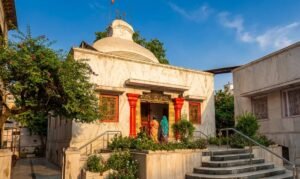
Bahula Shaktipeeth has a modest and peaceful temple structure that reflects the simplicity of a rural Bengal shrine. The temple is often recognized by its soft pink tones, open mandap, simple pillars, and quiet courtyard. The space does not try to impress the devotee through height or ornamentation. Instead, it invites one to slow down. The courtyard, the shrine, the sound of bells, the fragrance of incense, and the sight of Maa’s sanctum together create an atmosphere where prayer becomes natural. Many devotees who visit larger temples are surprised by how calm this place feels.
The temple complex includes the main shrine of Maa Bahula and associated sacred spaces connected with Bhairav and other deities. The image of Maa is treated with deep reverence, adorned with cloth, flowers, ornaments, and vermilion according to the day’s worship. The presence of Shri Ganesha and Shri Kartikeya gives the sanctum a family-like spiritual feeling. In Shakti temples, the devotee often experiences Maa as both the cosmic power of creation and the intimate mother who understands suffering without explanation. Bahula Shaktipeeth carries this feeling very strongly.
The location near the old religious landscape of Ketugram adds to the temple’s character. Some accounts describe the temple as being on or near the Ajay river region, while present-day mapping places the shrine within Ketugram village, away from the immediate riverbank. For devotees, the exact geographic shift in description does not reduce the sanctity. The temple’s spiritual identity remains rooted in the Shakti Peeth tradition, the local land, and the continued worship of Maa Bahula.
Festivals, Rituals, and the Devotional Life of the Temple
Bahula Shaktipeeth becomes especially vibrant during Navratri, Durga Puja, Kali Puja, and Maha Shivaratri. In Bengal, the worship of the Divine Mother reaches a very emotional height during Durga Puja. Even in smaller temples, the atmosphere becomes filled with flowers, lamps, mantras, drums, and the deep feeling that Maa has come close to her children. At Bahula, devotees seek blessings for family welfare, protection, prosperity, children, courage, and relief from difficulties. The festival days bring more pilgrims from nearby areas such as Katwa, Bardhaman, and surrounding villages.
Navratri is especially important because it honors the many forms of Maa. During these days, devotees may offer flowers, fruits, sweets, red cloth, sindoor, coconut, and prayers according to local practice. Maha Shivaratri also has significance because every Shakti Peeth is connected with Bhairav, and here Bhairav Bhiruk is remembered as the guardian form of Lord Shiva. Devotees who understand the deeper meaning of Shakti Peeth worship know that offering prayers to both Maa and Bhairav completes the pilgrimage.
Daily worship usually includes morning and evening prayers, offering of flowers and sweets, lighting of lamps, and simple darshan. The rhythm is less commercial and more personal. A devotee may find priests, local caretakers, or villagers guiding the worship in the traditional way. The beauty of Bahula is that it allows the devotee to pray without hurry. In the silence between the bell sounds, one can feel that Maa’s presence does not need loud display. Her blessing often arrives like quiet strength.
Darshan Experience and Why Devotees Visit Maa Bahula
Darshan at Bahula Shaktipeeth feels different from the experience of a crowded city temple. The devotee arrives through the rural roads of Ketugram, sometimes after changing transport at Katwa or Bardhaman, and the journey itself becomes part of the pilgrimage. By the time one reaches the temple, the mind has already moved away from daily noise. The sight of the simple temple, the open space, and the quiet surroundings creates an immediate feeling of humility. This is Maa’s place, and one enters with folded hands.
Devotees come to Maa Bahula for protection, prosperity, family peace, health, courage, and the removal of unseen obstacles. The symbolism of the fallen arm makes this temple especially meaningful for people seeking strength to act rightly in life. The arm serves, protects, works, embraces, and carries responsibility. In the same way, Maa Bahula is remembered as the Mother who gives devotees the ability to carry their duties without breaking inside. Many people also visit when they are passing through the Shakti Peeth circuit of West Bengal, combining Bahula with nearby sacred places like Attahas, Kankalitala, Tarapith, Kalighat, and Jogadya.
A simple mantra that devotees can remember here is: Om Aim Hreem Kleem Chamundayai Vichche. This mantra invokes the protective and transformative power of the Divine Mother. Its meaning is not limited to words, but its feeling is a prayer for Maa to remove negativity, awaken strength, and guide the devotee toward dharma. At Bahula Shaktipeeth, such prayer feels deeply personal, like speaking to a mother who already knows the pain and hope in the heart.
A Devotional Closing from the Heart
Bahula Shaktipeeth is not only a destination for those counting the 51 Shakti Peethas. It is a place for anyone who wants to feel Maa in a simple, grounded, and intimate way. The temple does not need grandeur to prove its power. Its power is in the faith of those who arrive quietly, offer flowers, bow their heads, and leave with a little more courage than they came with. In the soft rural air of Ketugram, Maa Bahula teaches that divine strength can be gentle and divine abundance can be silent.
For LiveDarshanHub.com, this temple page should help devotees understand not only the route and darshan details, but also the living bhav of the place. Maa Bahula is the Mother who gives strength to the arm, steadiness to the mind, and protection to the family. May Maa Bahula and Bhairav Bhiruk bless every devotee with courage, prosperity, protection, and a heart filled with Shakti bhakti. Jai Maa Bahula.
माँ बहुला और भैरव भीरुक सभी भक्तों को शक्ति, सुरक्षा, समृद्धि और अटूट भक्ति का आशीर्वाद दें। जय माँ बहुला।
Darshan & Aarti Timings
🚪 Darshan Timings
🪔 Aarti Schedule
⭐ Best Time to Visit
⚠️ Timings may change on festivals, special occasions, or during temple renovation. Please verify with the temple before visiting.
Visitor Information
🗺️ Location & How to Reach
Airport: Kazi Nazrul Islam Airport, Durgapur, about 110 to 125 km by road; Netaji Subhas Chandra Bose International Airport, Kolkata, about 150 to 170 km by road
Katwa Junction Railway Station, about 8 to 12 km; Ambalgram Railway Station, about 8 km; Bardhaman Railway Station, about 65 to 70 km
Ketugram local bus stop, about 200 meters to 1 km depending on drop point; Katwa Bus Stand, about 10 to 12 km
🧭 Detailed Directions
The nearest useful airport for Bahula Shaktipeeth is Kazi Nazrul Islam Airport at Andal near Durgapur, located about 110 to 125 km by road depending on the route. Devotees may also use Netaji Subhas Chandra Bose International Airport in Kolkata, which is better connected for national and international travel and is about 150 to 170 km from Ketugram by road. From either airport, devotees should continue by hired car, taxi, or a combination of train and local transport. Travel time from Kolkata may range from 4 to 5.5 hours depending on traffic, road condition, and local congestion near Katwa and Ketugram.
By Train
Katwa Junction is the most practical railway station for most devotees visiting Bahula Shaktipeeth. From Katwa, local buses, autos, e-rickshaws, cycle rickshaws, and hired cars are available toward Ketugram. The distance is commonly described as around 8 to 12 km depending on the exact route and drop point. Ambalgram Railway Station is also nearby, around 8 km from the temple, but train connectivity may be more limited. Bardhaman Railway Station is a larger railhead, about 65 to 70 km away, and can be used by devotees coming from Kolkata, Howrah, Durgapur, or other parts of West Bengal.
By Road
Bahula Shaktipeeth is located in Ketugram near Katwa in Purba Bardhaman district. From Katwa, devotees can reach the temple in about 25 to 40 minutes by local road transport. From Bardhaman, the road journey may take around 2 to 2.5 hours depending on route and traffic. From Kolkata, the road distance is roughly 150 to 170 km, and devotees should plan a full-day trip if returning the same day. Roads near the village may be narrower than city roads, so it is better to travel in daylight, especially for first-time visitors.
By Local Transport
Local buses, autos, cycle rickshaws, e-rickshaws, and small hired vehicles connect Katwa and nearby areas with Ketugram. On festival days such as Navratri, Durga Puja, Kali Puja, and Maha Shivaratri, local movement can become busier, and temporary arrangements may vary. Devotees should keep some extra time for the final approach, carry water, and confirm the return transport before staying late in the evening, as rural transport frequency may reduce after dark.