📜 About Bimala Temple (Shakti Peeth), Puri
The Sacred Shakti Peeth Within Jagannath Dham
In the sacred city of Puri, where the name of Shri Jagannath flows through every street, there is a quiet but immensely powerful shrine inside the great temple complex. This shrine is Bimala Temple, dedicated to Maa Bimala, also lovingly called Maa Vimala. For many devotees, the first thought of Puri is Lord Jagannath, Lord Balabhadra, and Maa Subhadra, yet those who understand the deeper spiritual heart of the temple know that Maa Bimala holds a very special place. She is not outside the Jagannath tradition. She is at its inner center, guarding the sacred space and completing the offering of Mahaprasad.
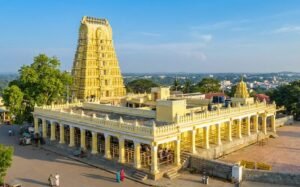
Bimala Temple is situated in the south-western part of the inner enclosure of the Shree Jagannath Temple complex, near the sacred Rohini Kunda. The temple may appear small when compared with the massive Jagannath temple tower, but its spiritual importance is enormous. It is regarded as a Shakti Peeth, one of the holy places where the body parts of Maa Sati are believed to have fallen. In the Puri tradition, this sacred site is associated with the feet of Maa Sati, known in some Shakti Peeth lists as Pada Khanda. This gives the shrine a very tender meaning. Feet are the place where devotees bow, surrender, and receive grace. At Maa Bimala’s shrine, the devotee feels that the whole journey of Puri becomes complete only when one bows at Maa’s feet.
The Legend of Maa Sati and the Spiritual Meaning of Bimala Shakti Peeth
The sacredness of Bimala Temple is connected with the timeless story of Maa Sati and Lord Shiva. Maa Sati, daughter of King Daksha, chose Lord Shiva as her divine husband. Daksha, filled with pride, could not accept Shiva’s ascetic and unconventional form. When Daksha organized a great yajna and insulted Lord Shiva by not giving him proper honor, Maa Sati could not bear the disrespect shown to her Lord. In deep sorrow and spiritual fire, she gave up her body. When Lord Shiva came to know of her sacrifice, his grief shook the universe. Carrying the body of Sati, he began the cosmic Tandava, and all creation trembled.
To restore balance, Lord Vishnu used his Sudarshan Chakra, and the body of Maa Sati was divided into sacred parts that fell at different places. These places became the Shakti Peethas, where the Divine Mother is worshipped in many forms. Puri is revered in this tradition as the place where Maa Sati’s feet are believed to have fallen. Some traditions across India preserve different local variations, but the Puri Shakta tradition strongly honors Maa Bimala as the presiding Shakti of this Peeth. The spiritual meaning is beautiful. The feet of the Mother are the refuge of the devotee. They carry the power of humility, surrender, travel, and protection. A devotee who comes to Maa Bimala does not come with pride. One comes with folded hands, asking for purification of the heart.
A powerful Devi mantra often remembered at Shakti Peethas is: Ya Devi Sarva Bhuteshu Shakti Rupena Samsthita, Namastasyai Namastasyai Namastasyai Namo Namah. Its meaning is, “To the Goddess who abides in all beings as power, I bow again and again.” At Bimala Temple, this mantra feels very natural because Maa’s presence is quiet, ancient, and deeply rooted in the living worship of Puri.
Maa Bimala, Shri Jagannath, and the Mystery of Mahaprasad
The relationship between Maa Bimala and Shri Jagannath is one of the most beautiful spiritual features of Puri. In many Shakti Peeth traditions, every Shakti has a Bhairava, the guardian divine presence connected with the Peeth. At Bimala Temple, Shri Jagannath himself is honored as the Bhairava of Maa Bimala, often remembered as Jagannatheshwar. This is a rare and profound synthesis where Vaishnav, Shakta, Shaiva, and Tantric streams meet without conflict. Puri teaches that divine truth is wide enough to hold many paths together.
Maa Bimala is regarded as the guardian goddess of the Jagannath temple complex. The most famous expression of her importance is seen in the Mahaprasad tradition. Food first offered to Shri Jagannath becomes fully sanctified as Mahaprasad only after it is offered to Maa Bimala. This means that the Mother completes the blessing of the Lord’s food. Devotees who eat Mahaprasad in Puri are receiving not only the grace of Jagannath, but also the approval and blessing of Maa Bimala. This tradition gives the shrine a living role in everyday temple worship. Maa Bimala is not remembered only during festivals. She is present in the daily sacred food cycle of Jagannath Dham.
The Odisha devotional tradition preserves a beautiful legend that Maa, in the form of Bimala, receives the remnants of Vishnu’s food in Kali Yuga. The feeling behind this story is not smallness, but sacred intimacy. The Mother accepts what has touched the Lord, and by her acceptance, the food becomes available as a blessing for the world. When a devotee holds Mahaprasad in Puri, the unseen presence of Maa Bimala is part of that grace.
History, Architecture, and the Ancient Kalinga Temple Form
Bimala Temple is considered one of the older shrines within the Shree Jagannath Temple complex. The central icon is often associated with an early period, and the present structure is generally linked with the 9th century CE in its architectural form. The temple is built in the traditional Kalinga Deula style, using sandstone and laterite. It faces east and contains the main parts of an Odishan temple plan, including the vimana, jagamohana, nata mandapa, and bhoga mandapa. Though modest in size, the temple carries the dignity of ancient Odisha temple architecture.
The vimana rises in Rekha Deula form, and the temple walls preserve sculptural language that connects Shakta, Shaiva, and Odishan artistic traditions. The shrine stands close to Rohini Kunda, one of the ancient sacred spots within the Jagannath temple precinct. This closeness adds to the sense that Maa Bimala’s presence belongs to the older sacred memory of Puri. The temple has also been associated with the Archaeological Survey of India’s preservation work and was renovated around 2005.
The icon of Maa Bimala is deeply distinctive. She is not shown in a heavily armed, terrifying form alone. Traditional descriptions remember her as peaceful and majestic, holding a rosary and a pitcher connected with nectar. Her face carries a benevolent expression, reminding devotees that Shakti is not only fierce destruction of evil, but also nourishment, long life, devotion, and inner purity. At the entrance, the image of a lion over an elephant symbolizes the victory of good over powerful negativity. For a devotee, every stone detail feels like a teaching. Maa destroys pride, but she protects the surrendered heart.
Durga Puja, Secret Rituals, and the Shakta Soul of Puri
The most important festival connected with Maa Bimala is Durga Puja, celebrated here with special depth. Unlike the nine-day form of Navratri familiar in many places, Bimala Temple has a sixteen-day Durga Puja tradition within the Jagannath temple complex. During this period, the Shakta energy of Puri becomes especially intense. Maa is worshipped with special rituals, mantras, offerings, and traditional temple customs. For Shakta devotees, this time is spiritually powerful because Maa Bimala is invoked not only as a gentle mother, but also as the cosmic force who protects dharma.
The Jagannath tradition is known for its wide and inclusive nature. Within the same sacred complex, one finds Vaishnav devotion to Jagannath, Shakta worship of Maa Bimala, Shaiva links through Bhairava symbolism, and ancient Tantric memories. Some traditional rituals of Maa Bimala during Durga Puja are performed privately according to temple custom. These practices reflect the old Shakta and Tantric layers of Odisha’s spiritual history. A devotee does not need to witness every inner ritual to feel the power of the place. The atmosphere itself becomes charged with Maa’s presence.
Other important times for worship include Navratri, Vijayadashami, Ashwin month observances, and major Jagannath temple festivals such as Rath Yatra, Snana Purnima, Chandan Yatra, and Kartik month rituals. Even though Maa Bimala has her own Shakta identity, her shrine lives inside the daily and yearly rhythm of Jagannath Dham. This is what makes Puri unique. Here the Mother and the Lord are not separate destinations. They complete one another.
The Darshan Experience Inside the Jagannath Temple Complex
Darshan of Maa Bimala usually comes as part of a larger pilgrimage inside the Shree Jagannath Temple complex. A devotee first enters through the sacred gates of the great temple, after passing security and leaving behind footwear, mobile phones, cameras, and other restricted items. The atmosphere inside is unlike any ordinary place. The sound of bells, the movement of sevayats, the fragrance of Mahaprasad, the sight of ancient shrines, and the towering presence of Jagannath Mahaprabhu all prepare the mind for surrender. Somewhere within that sacred movement, the devotee turns toward Maa Bimala’s shrine.
Standing before Maa Bimala, the mood becomes quieter. The shrine is not usually as visually dominant as the main Jagannath sanctum, yet it has a deep gravity. Devotees bow to Maa with the feeling that she is the silent protector of the entire temple. Some offer prayers for family safety, health, prosperity, courage, removal of obstacles, and purity of mind. Others simply thank Maa before taking Mahaprasad. Many traditional pilgrims believe that a visit to Puri is incomplete without the darshan of Maa Bimala, because she is the Shakti who sanctifies the Dham from within.
A simple prayer to Maa may be offered in the heart: Om Hreem Bimalayai Namah. Its meaning is, “I bow to Maa Bimala, the pure and radiant Divine Mother.” The name Bimala itself suggests purity. In her presence, the devotee asks not only for success, but for a clean mind, a softened heart, and a life guided by dharma.
A Devotional Closing from the Heart
Bimala Temple is one of those sacred places whose greatness is felt more in silence than in outward display. Inside the vast spiritual world of Jagannath Puri, Maa Bimala sits with ancient dignity, reminding every devotee that Shakti is the hidden force behind every offering, every blessing, and every step of pilgrimage. She is the Mother who accepts the Lord’s food and turns it into Mahaprasad for the world. She is the Shakti Peeth where devotees bow to the sacred feet of Maa Sati. She is the guardian of Puri’s inner sanctity.
For LiveDarshanHub.com, this temple page should help devotees understand that Jagannath Dham is also a living Shakti Peeth. A visit to Maa Bimala gives depth to the Puri pilgrimage and fills the heart with reverence for the Mother’s quiet power. May Maa Bimala and Shri Jagannath bless every devotee with purity, protection, Mahaprasad grace, and unwavering bhakti. Jai Maa Bimala.
माँ बिमला और श्री जगन्नाथ सभी भक्तों को पवित्रता, सुरक्षा, महाप्रसाद की कृपा और अटूट भक्ति प्रदान करें। जय माँ बिमला।
Darshan & Aarti Timings
🚪 Darshan Timings
🪔 Aarti Schedule
⭐ Best Time to Visit
⚠️ Timings may change on festivals, special occasions, or during temple renovation. Please verify with the temple before visiting.
Visitor Information
🗺️ Location & How to Reach
Airport: Biju Patnaik International Airport, Bhubaneswar, about 60 km
Puri Railway Station, about 3 km
Puri Bus Stand, about 3 km; Malatipatpur Bus Terminal, about 7 km
🧭 Detailed Directions
The nearest airport for Bimala Temple is Biju Patnaik International Airport in Bhubaneswar, located about 60 km from Puri. From the airport, devotees can reach Puri by taxi, app cab, private car, or airport-linked road transport. The journey generally takes around 1.5 to 2 hours depending on traffic. During Rath Yatra, Snana Purnima, New Year, Kartik month, and major holiday periods, travel time can increase because of heavy pilgrim movement toward Jagannath Dham.
By Train
Puri Railway Station is the most convenient railhead, located about 3 km from the Shree Jagannath Temple complex. It is well connected with Bhubaneswar, Kolkata, Delhi, Chennai, Ahmedabad, Mumbai, and many other cities through regular trains. From the railway station, devotees can take an auto rickshaw, cycle rickshaw, taxi, e-rickshaw, or local transport toward the temple area. The final approach near the temple is usually managed through pedestrian routes and local traffic regulations.
By Road
Puri is well connected by road with Bhubaneswar, Cuttack, Konark, and other parts of Odisha. From Bhubaneswar, the road distance is about 60 km and the journey usually takes around 1.5 to 2 hours. From Konark, Puri is about 35 km away and the coastal road journey is spiritually and visually beautiful. Devotees traveling by private vehicle should note that parking near the Jagannath Temple is regulated, and walking or using local transport may be required for the final stretch.
By Local Transport
Inside Puri, auto rickshaws, cycle rickshaws, e-rickshaws, taxis, and local buses are available for reaching the Jagannath Temple area. Since Bimala Temple is located inside the Shree Jagannath Temple complex, devotees must follow the same entry route and temple rules as Jagannath Temple visitors. During Rath Yatra, Kartik month, weekends, and major festivals, police and temple administration may introduce special barricades, queue systems, and pedestrian routes. Devotees should travel light and keep extra time for security checks.