📜 About Shree Jagannath Temple — Puri Dham
The God Who Laughs — and Why That Matters More Than You Think
Let us start with the image. Because in Jagannath’s case, the image is everything.
In the main sanctum of the Jagannath Temple — accessible only to Hindus, and even then approached through multiple corridors of intense crowd and incense and bells — there are three deities on the altar. Lord Jagannath in the centre, flanked by his brother Balabhadra (Balarama) on the left and his sister Subhadra on the right. All three are made of sacred neem wood, carved in a style that has no parallel anywhere in Indian religious art. Round. Simple. Abstract. With circular, black-and-white eyes so large they seem to take up the entire face. With mouths open. With bodies that suggest rather than depict the human form.
The first time most people see the Jagannath image — whether in person at Puri or in a photograph — their reaction is confusion, sometimes even discomfort. This doesn’t look like a Hindu deity. Where are the intricate carvings, the delicate features, the recognizable iconography? Why does the Lord of the Universe look like this?
The answer, once you hear it, changes how you see everything.
According to the most widely told tradition, the image of Jagannath was being carved by the divine craftsman Vishwakarma himself — with the specific instruction that no one should disturb him until the work was complete. But after many days, King Indradyumna — who had commissioned the image — could not contain his impatience. He opened the door of the workshop before the image was finished. Vishwakarma, true to his warning, immediately disappeared. And the image was left exactly as it was — unfinished, arms not yet formed, the rough neem wood of the torso still visible, but the face already complete and those great eyes already open and already full of divine presence.
Lord Jagannath himself appeared to the distressed king and said: “Do not grieve. This is how I choose to appear. This incomplete form is my chosen form. Because I, who am the Lord of all the universes, am also in the process of becoming — always unfinished, always still being created. And in this unfinished form I am most approachable, most human, most real.”
Think about that for a moment. The Lord of the Universe chose to remain incomplete as an act of theological humility. As a declaration that perfection is not the point. That the divine is not a finished, static thing but something constantly in the process of emergence, constantly becoming, never done.
Those open eyes have been watching the sea for three thousand years. They are still watching. Still becoming. Still open.
The Rath Yatra — When God Goes for a Walk
Once a year, usually in June or July, Lord Jagannath, Balabhadra, and Subhadra leave their temple. They come out into the streets of Puri on three enormous wooden chariots — each one newly built every year, each one a multi-storey wheeled structure decorated with colourful fabric and topped with a distinctive curved roof. Hundreds of thousands of devotees — sometimes over a million — come to Puri for this one day. They fill every street and rooftop and window. And when the chariots begin to move, pulled by thousands of volunteers using thick rope, the sound of that crowd is like nothing else on earth.
This is the Rath Yatra — the Chariot Festival. One of the largest human gatherings in the world. Listed by UNESCO as an intangible cultural heritage. The word juggernaut in the English language comes directly from Jagannath — early European travellers who witnessed the Rath Yatra were so overwhelmed by the scale of it, by the sight of those massive chariots rolling through the ocean of people, that the word entered the English language to mean any large, unstoppable force.
But the deeper significance of the Rath Yatra is not the spectacle. It is the theology. By coming out of the temple — by placing himself in the streets where everyone, including those who are not allowed inside the temple, can see him — Lord Jagannath is making a specific, radical, deeply democratic statement: I belong to everyone. Not just to those with the right caste or the right ritual purity or the right credentials. I belong to everyone who has eyes to see and a heart to love.
The tradition says that anyone who pulls the rope of Jagannath’s chariot — anyone at all, regardless of their social position, their caste, their past — receives immediate liberation from the cycle of birth and death. Kings and sweepers pull the same rope. That, in a caste-stratified society, is a genuinely revolutionary act of grace.
The chariot procession goes from the main Jagannath Temple to the Gundicha Temple — Jagannath’s aunt’s house, 3 kilometres away — where the deities stay for nine days before returning in a procession called Bahuda Yatra. The Gundicha Temple is said to represent the garden of Vrindavan — so the Rath Yatra is, symbolically, the Lord’s journey back to his childhood home, back to the place where he was Krishna the cowherd before he became Jagannath the Lord of the Universe. Even gods, the festival says, need to go home sometimes.
The Temple — The Flag That Defies the Wind
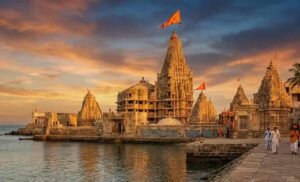
The Jagannath Temple complex is one of the most extraordinary architectural ensembles in India. The main temple — called the Bada Deul (great temple) — rises 65 metres above the ground, a massive Kalinga-style tower with a complex of subsidiary temples and mandapams built up around it over centuries. The entire complex covers an area of about 10 acres, enclosed by a high compound wall called Meghanada Prachira.
The main entrance is through the Singhadwara (Lion Gate) on the eastern side — so called because two massive stone lions flank the entrance. Above the main gate is a carved panel of Lord Surya (the Sun God), and the first thing you see as you pass through is the great tower rising above you, its surface covered in an intricate web of carved figures, deities, and celestial beings.
The most extraordinary feature of the Jagannath Temple is its flag. Like Dwarka, the flag flies from the top of the main shikhara and is changed every day. But what makes this flag so remarkable is a phenomenon that has been noticed and documented for centuries: the flag always flies in the opposite direction of the wind. When the sea breeze blows from the east toward the west, the flag flies toward the east. This has no scientific explanation that has yet satisfied everyone who has studied it. For devotees, it requires no explanation at all. For the curious, it is one of those details that keeps you thinking long after you have left Puri behind.
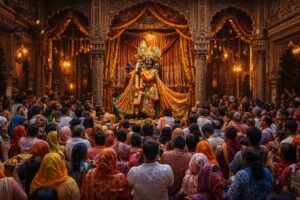
Inside the main sanctum, the darshan of Lord Jagannath is an experience that is difficult to describe to someone who has not had it. The three deities — Jagannath, Balabhadra, Subhadra — are elevated on the altar above the crowd. The press of devotees, the smell of flowers and ghee and incense, the sound of bells and chanting, and then — through the crowd, over the heads, catching a glimpse of those enormous eyes — the feeling is not of distance, not of majesty, but of recognition. As if those eyes were waiting for you specifically. As if you had been expected.
The Mahaprasad — Food as Theology
The Jagannath Temple has the largest temple kitchen in the world. Every single day, the kitchen — called the Ananda Bazar (Market of Bliss) — cooks enough food for between 10,000 and 100,000 people, depending on the day and the season. During Rath Yatra, the kitchen feeds over a million people.
The food cooked here is called Mahaprasad — the great blessed food — and it is considered one of the most sacred foods in all of Hinduism. The Mahaprasad of Jagannath is unique in several ways:
- It is cooked entirely in earthen pots stacked one on top of another, over a wood fire. The upper pot is always believed to cook first, regardless of the physics of heat distribution — a phenomenon that devotees point to as evidence of Jagannath’s grace and that food scientists have never fully explained.
- It is prepared by the Suaras — a specific caste of temple cooks — but is accepted and distributed to all visitors regardless of caste. The Mahaprasad is explicitly considered to be purifying in and of itself — touching the Mahaprasad nullifies caste distinctions.
- When the Mahaprasad is purchased in the Ananda Bazar, buyers traditionally sit on the ground to eat it, regardless of their social status. Kings and commoners have eaten on the same ground level. The Mahaprasad is served on leaf plates in the open-air market every day, and pilgrims eat together in a demonstration of equality that is simultaneously very ancient and very radical.
The great 15th-century saint Kabir wrote: “Moko kahan dhundhe re bande, main to tere paas mein” — “Where do you seek me, O devotee? I am right here with you.” The Mahaprasad of Jagannath is a manifestation of that teaching. The divine is not in the innermost sanctum alone. It is in the earthen pot on the fire. It is in the leaf plate on the ground. It is in the act of eating together, without distinction, in the shadow of a god who chose to remain incomplete so that no one would feel too small to approach him.
The Navakalevara — When the Gods Are Reborn
One of the most extraordinary traditions at Jagannath Puri is the Navakalevara — the ritual renewal of the wooden images of Jagannath, Balabhadra, and Subhadra. Since the deities are made of neem wood, they gradually decay, and every 8, 12, or 19 years (the interval is determined by a specific combination of the Hindu lunar calendar — when two Ashadha months occur in the same year), the old images are ceremonially buried and new ones are carved from freshly selected sacred neem trees and installed.
The finding of the sacred neem trees — guided by specific omens including the presence of certain birds, specific markings on the bark, and the proximity of ant hills and snake burrows — is itself a months-long ritual process. The carving of the new images is done by a hereditary caste of carpenters called Daitapatis, who work in complete darkness and silence, their eyes and hands bound with cloth, working by touch alone. Inside the new image, the old image’s Brahma Padartha — a mysterious sacred substance, never seen by non-priests, believed to be the divine essence itself — is transferred from old to new.
The last Navakalevara was in 2015. The next will be sometime around 2034-2035. If you have the opportunity to witness even the outer ceremonies of a Navakalevara — the search for the trees, the procession of the images, the immersion of the old forms — it is an experience that very few people in a generation receive.
Aarti & Daily Rituals
The Jagannath Temple conducts an elaborate schedule of five main aartis and sixteen daily rituals called Shodasha Upacharas — a sequence of offerings from the earliest morning to the final night puja that treats the deity as a divine king being served through all the activities of a royal day:
- Mangala Aarti: 5:00 AM — Pre-dawn awakening; the deity is shown a mirror (as a king sees his face on waking), then dressed in morning clothes and offered early breakfast
- Mailam: 6:00 AM — The daily changing of the deity’s clothes
- Abakasha (Breakfast): 7:00 AM — Morning food offering; includes specific items for each deity
- Madhyanha Dhupa (Midday): 12:00 PM — Main midday offering; the most elaborate food ritual of the day
- Sandhya Aarti: 7:00 PM — Evening aarti; the deities are dressed for evening and offered the sandhya food
- Bada Shringar: 8:00 PM — Grand evening decoration; the deities are dressed in their most elaborate evening attire — this is the most visually spectacular darshan of the day
- Pahuda (Shayan Aarti): 11:00 PM — Final ritual; the deities are put to rest for the night with a specific lullaby sung by the priests
Major Festivals
- Rath Yatra (June/July): The defining festival of Puri and one of the largest human gatherings in the world. Three chariots. Over a million devotees. The word “juggernaut” in English. Book accommodation months in advance — hotels in Puri are sold out a year ahead for Rath Yatra.
- Snana Yatra: The bathing festival, one month before Rath Yatra — when the deities are brought out for a ceremonial bath. After the bath, the deities are considered ritually unwell (from the exposure to the public) and are kept in seclusion for 15 days — called Anasara — during which special doctors attend them.
- Bahuda Yatra: The return Rath Yatra — when the deities return from Gundicha Temple to the main temple after their nine-day visit
- Janmashtami: Birthday of Lord Krishna — celebrated with particular energy since Jagannath is understood as a form of Krishna
- Diwali: Grand lamp festival; the temple and the entire beachfront town illuminate
- Navakalevara (Every 8-19 years): The most extraordinary of all — when the wooden deities are reborn. Next estimated around 2034-35.
How to Reach Puri
By Air: The nearest airport is Biju Patnaik International Airport, Bhubaneswar (60 km from Puri). Bhubaneswar has flights from Delhi, Mumbai, Kolkata, Hyderabad, Chennai, Bengaluru, and several other cities. From the airport, taxis take about 1 hour to Puri.
By Train: Puri Railway Station is the most convenient option — just 2 km from the Jagannath Temple. Puri is directly connected to Delhi (Purushottam Express, Neelachal Express), Kolkata (Jagannath Express), Mumbai, Chennai, and Bhubaneswar. The Puri station is among the most photographed railway stations in India, with its beautiful blue paintwork and its atmosphere of continuous pilgrimage.
By Road: Puri is 60 km from Bhubaneswar, 490 km from Kolkata, and 1,750 km from Delhi. NH-316 connects Puri to Bhubaneswar. Regular OSRTC buses from Bhubaneswar, Cuttack, and other Odisha cities. The drive from Bhubaneswar — past the Dhauli Peace Pagoda (where Ashoka’s transformation happened) and through the coastal Odisha countryside — is scenic and historically rich.
Essential Tips
- 🙏 Non-Hindus and the temple: Non-Hindus are not permitted inside the Jagannath Temple — a rule that has been in place for centuries and is strictly enforced. However, the Raghunandan Library across the street has a viewing platform from which the top of the temple and the flag can be seen.
- 📸 Photography: Strictly prohibited inside the temple and near the main gate. All cameras and phones must be deposited in the cloakroom at the Lion Gate.
- 🎪 Rath Yatra: If visiting during Rath Yatra (check dates — lunar calendar varies by year), arrive a day early and find a spot on Grand Road (Bada Danda) by 6 AM for the chariot procession. The crowd is enormous but disciplined.
- 🍛 Mahaprasad: Absolutely do not leave Puri without eating the Mahaprasad from the Ananda Bazar. Eat on the ground, as tradition prescribes, from a leaf plate. This is non-negotiable.
- 🌊 Puri Beach: The beach at Puri is one of the great beaches of eastern India. Sunrise here — with the Jagannath Temple tower visible behind you and the sea in front — is a genuinely beautiful morning experience.
Nearby Attractions
- Gundicha Temple (3 km) — Jagannath’s aunt’s house; destination of Rath Yatra
- Puri Beach — One of Odisha’s finest beaches; famous for sand art
- Konark Sun Temple (35 km) — UNESCO; the Black Pagoda; one of India’s greatest architectural masterpieces
- Chilika Lake (50 km) — Asia’s largest coastal lagoon; Irrawaddy dolphins and migratory birds
- Bhubaneswar (60 km) — The temple city of India; 700+ ancient temples including Lingaraj
- Dhauli (68 km) — Where Ashoka renounced violence after the Kalinga War; rock edicts and peace pagoda
- Raghurajpur (14 km) — Heritage crafts village; birthplace of Pattachitra painting tradition
Why Jagannath Is the Char Dham of Joy
Hindus have a concept called ananda — bliss, joy, the experience of happiness that is not dependent on any circumstance, that comes from the nature of existence itself rather than from anything that happens in it. The Upanishads say that the ultimate nature of Brahman — the universal consciousness — is Sat-Chit-Ananda: Being-Consciousness-Bliss. The universe, at its deepest level, is not suffering. It is joy.
Jagannath is that joy.
Not the polished joy of perfection, but the wild, uncontrollable, incomplete joy of a god who laughed so hard he froze in the middle of it. The joy of the Rath Yatra, when a million people pull a chariot through the streets and the boundary between devotee and deity dissolves completely. The joy of the Mahaprasad, when everyone sits on the same ground and eats from the same leaf and the distinction between sacred and ordinary disappears into a shared meal. The joy of those enormous eyes, which have been watching humans for three thousand years and, by all appearances, still find us endlessly fascinating, endlessly worthy of that wide-open gaze.
Come to Puri with your burdens. Come with your theology intact or in tatters. Come as a believer or a skeptic or something in between. Stand at the Singhadwara and let the bells wash over you. Eat the Mahaprasad on the ground. Watch the flag flying against the wind.
Let the Lord of the Universe laugh with you. Or at you. The difference, from where he sits, may not be very large.
Either way, you will leave lighter than you came.
🗿 Temple Murti / Statue
भगवान जगन्नाथ, बलभद्र और सुभद्रा — पुरी धाम, ओडिशा
Darshan & Aarti Timings
🚪 Darshan Timings
🪔 Aarti Schedule
⭐ Best Time to Visit
⚠️ Timings may change on festivals, special occasions, or during temple renovation. Please verify with the temple before visiting.
Visitor Information
🗺️ Location & How to Reach
Biju Patnaik International Airport, Bhubaneswar (60 km)
Puri Railway Station (2 km from temple)
Puri Bus Stand (1 km)